

The Federal Reserve’s newest survey shows a sharp drop for the typical Black family while other groups gained. The details matter, so here is exactly what the numbers say.
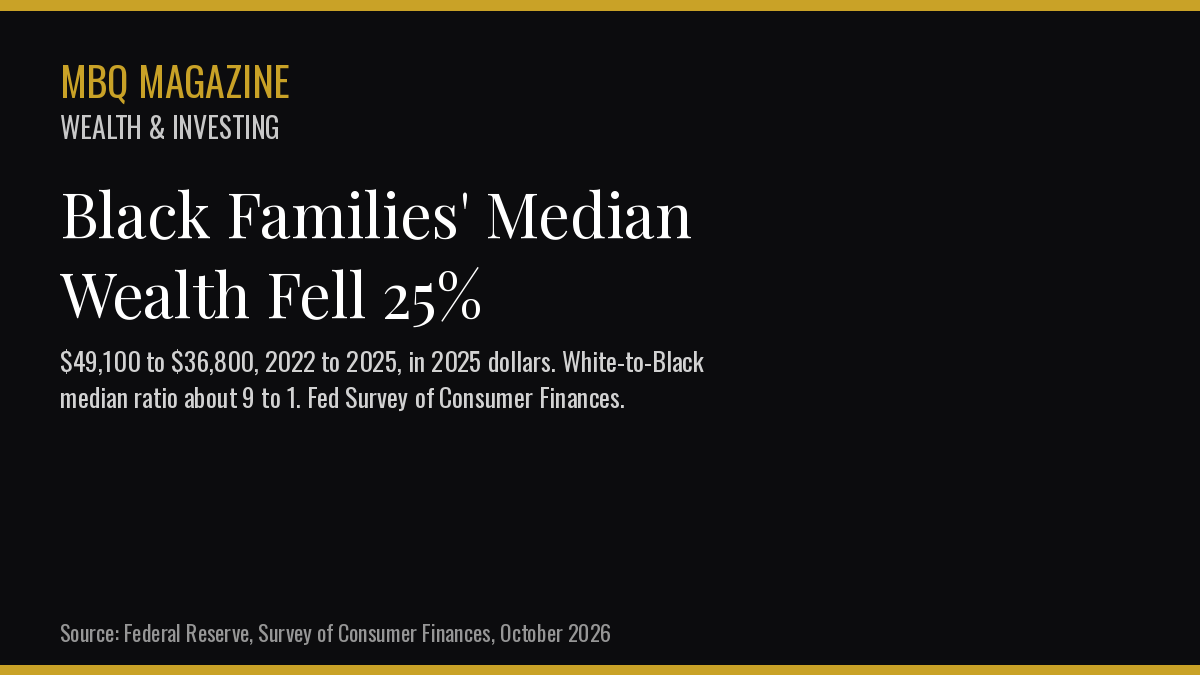
The headline number is real, and it needs precise wording. The Federal Reserve’s 2025 Survey of Consumer Finances, released in October, found that median net worth for Black non-Hispanic families fell 25% between 2022 and 2025, from about $49,100 to $36,800 after adjusting for inflation to 2025 dollars. The Fed’s report says that decline “stands in contrast to increases seen since the 2013 survey.”
This is a comparison of two surveys three years apart, not a one-year drop. And it is the median, the family in the exact middle. The same table shows the average net worth of Black families rose 5%, from about $231,400 to $242,400, which means the average rose even as the typical family’s wealth fell. An average can rise when a smaller number of families gain a lot, but the Fed’s table doesn’t show where the gains were.
The 9-to-1 gap
Over the same period, median net worth rose for every other group the Fed tracks, according to the report:
| Median net worth (2025 dollars) | 2022 | 2025 | Change |
|---|---|---|---|
| White non-Hispanic | $311,900 | $332,100 | +6% |
| Black non-Hispanic | $49,100 | $36,800 | −25% |
| Hispanic or Latino | $67,400 | $79,600 | +18% |
| Asian | $586,600 | $677,600 | +16% |
| All families | $211,100 | $215,900 | +2% |
The Fed says that “in 2025, median wealth for White non-Hispanic families was nine times that for Black non-Hispanic families, which is the largest ratio recorded since 2016.” By our calculation from the Fed’s tables, that ratio was about 9.7 to 1 in the 2016 survey, about 7.8 to 1 in 2019, about 6.4 to 1 in 2022 and about 9 to 1 in 2025, a difference in medians of roughly $295,000 in 2025.
A second Fed measure, a different story
The Fed also publishes quarterly estimates called the Distributional Financial Accounts. They are modeled: they spread national household-wealth totals across groups using the survey’s patterns, so they are not a fresh measurement each quarter. The latest release, updated Sept. 18, shows Black households held about 3.2% of total U.S. household net worth in the second quarter of 2026, down from 3.6% in early 2022 and 4.0% in 1989. White households held about 82.4%. That is a share of the nation’s total wealth, a different yardstick from the survey’s median family.
What the numbers do and don’t explain
The Fed’s report doesn’t give a single cause. It says changes in wealth “largely reinforced existing patterns of wealth inequality,” with groups that typically have less wealth, such as renters, young families and families without a high school diploma, seeing median declines.
The Center for Economic and Policy Research said its analysis “suggests that the decline in Black net worth is due in part to declines in the value of Black homes, vehicles, and retirement accounts,” and that “the percentage of Black households with nonfinancial assets dropped from 81 percent to 78.4 percent from 2022 to 2025.” Economist Gbenga Ajilore of the Center on Budget and Policy Priorities told The Grio that “what determines wealth is housing, and that’s where Black people have their wealth,” while groups with more stock-market holdings benefited from rising stock prices.
One caution: survey estimates carry sampling error, and the Fed notes that its 2025 sample deliberately oversampled families likely to be Black or Hispanic. Black families were about 13.9% of the survey population in 2025 versus 11.5% in 2022 (Fed, Table A.3). Treat the exact figure as an estimate, but the direction and size are what the Fed itself highlighted.
What builds wealth back
Some general takeaways from the Fed’s figures, for educational purposes:
- Own your home, and protect the equity. The median homeowner’s net worth was $458,900 in 2025, versus $10,600 for renters. Homeownership alone isn’t a guarantee, but the gap is enormous. Pay attention to mortgage terms, insurance and property taxes.
- Diversify beyond one asset. If your wealth is mostly your house and your car, a bad year in either hits hard. Many people use low-cost, diversified funds in a 401(k) or IRA to spread risk. If an employer match is offered, it is worth understanding how to capture it.
- Build the retirement account. The Fed found median and mean balances rose for families with account-type retirement plans between 2022 and 2025. Starting early, even small, gives a family another asset that isn’t tied to one house or one paycheck.
- Own a business or an income stream. Ownership can create assets that can be passed on, though business equity can be volatile: the Fed found median business equity among owners fell 23% from 2022 to 2025 (Table 3).
- Keep a cash cushion. Families in the bottom quarter of the wealth distribution saw median net worth fall 56%, from $3,800 to $1,700 (Fed, Table 2). Three to six months of expenses keeps a bad month from becoming a forced sale.
Wealth is built slowly and lost quickly. The Fed’s numbers are a reminder to check your own balance sheet, not just the national one.
This article is for educational purposes only and is not investment, tax or legal advice. MBQ Magazine does not recommend buying or selling any security. Consult a qualified financial professional about your situation.