

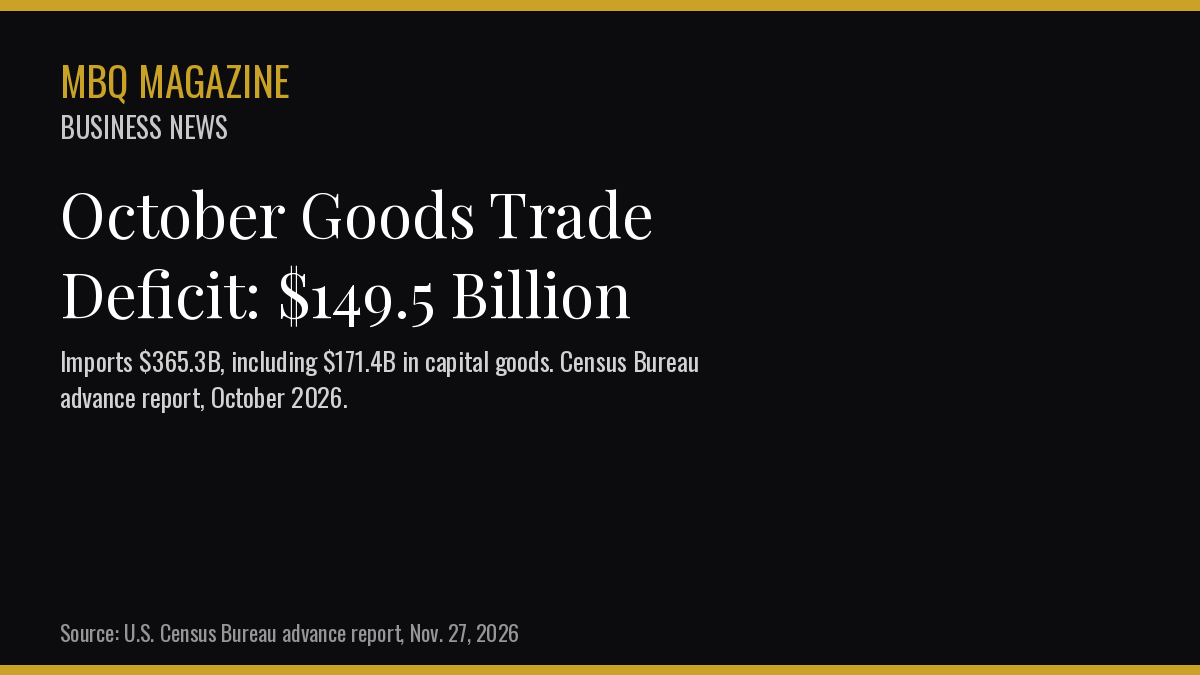
U.S. goods imports hit a record $365.3 billion in October, led by capital goods, a category that includes AI equipment. The same week, Washington proposed new tariffs on 14 economies.
The U.S. goods trade deficit jumped to $149.5 billion in October, up $14.4 billion from $135.1 billion in September, the Census Bureau reported on Nov. 27. Reuters attributed the surge to an AI infrastructure build-out, though Census’s advance report doesn’t break out AI equipment.
Exports of goods rose to $215.8 billion, up $6.7 billion. Imports rose to $365.3 billion, up $21.1 billion, according to the Census advance report. Two cautions apply. This report covers goods only, not services, and the figures are adjusted for seasonal patterns but not for price changes. It is also an advance estimate; the full report comes later.
The AI connection
Reuters reported that imports hit the highest level since the government began tracking the series in 1992. Capital goods imports, the machinery and equipment businesses buy to produce things, rose to $171.4 billion, up 8.5% from September and 80.0% from October 2025, the Census advance report shows. The deficit was the highest since March 2025, and economists polled by Reuters had expected $133 billion.
Reuters noted that the AI build-out is “heavily reliant on imports.” Census’s advance report doesn’t say how much of the capital-goods total is servers, chips or networking gear; more detail is due in the full report on Dec. 8.
The imports weren’t only AI. Reuters said consumer goods rose 2.6%, industrial supplies 6.0% and motor vehicles and parts 4.1%, which it described as reflecting strong domestic demand.
“Capital goods imports are surging, showing that AI doesn’t always lead to greater US economic growth,” Christopher Rupkey, chief economist at FWDBONDS, told Reuters. Economists at Goldman Sachs wrote that “this year’s surge in capital goods imports is one reason why AI is adding less to GDP than corporate spending figures suggest.”
That has a measurable effect. Trade subtracted 3.21 percentage points from third-quarter GDP growth, Reuters reported, though strong consumer spending and business equipment investment, mostly AI-related, more than offset it, and the economy grew at a 4.3% annualized rate. Goldman lowered its fourth-quarter growth estimate by 0.2 point to 2.2%.
What the number does and doesn’t say
A big deficit isn’t automatically a sign of weakness, and this one is a good example. Reuters noted that domestic demand, which includes business investment and consumer spending, grew in the third quarter at its fastest pace in more than five years. When American companies and households spend more, they buy more from abroad. In that sense, the deficit is partly a measure of appetite.
It also isn’t a measure of everything. The Census figure leaves out services, and a single month is easily moved by shipping schedules and the timing of large orders. Reuters reported that trade has not added to GDP growth for four straight quarters, so this is a pattern, not just one number. But the pattern is a drag on growth statistics, not proof the AI build-out is a bad bet. Goldman Sachs’s point is narrower: the economic lift from AI spending is smaller than the spending itself suggests, in part because of the surge in capital-goods imports.
For an owner, the practical reading is simple. The cost of AI hardware, and of the electronics that go with it, depends partly on trade policy, and trade policy is being rewritten right now.
The tariff collision
The week’s trade news was not only the deficit. On Nov. 25, U.S. Trade Representative Jamieson Greer determined that practices in 14 economies, including China, the European Union, Japan, India and Vietnam, relating to “structural excess capacity” in manufacturing are unreasonable and burden U.S. commerce, the USTR announced.
The tariffs are proposals, not rules in effect. USTR proposed these rates, most of them as “up to” ceilings, net of existing duties and with exemptions for certain goods:
- China: up to 20%, net of the existing forced-labor Section 301 rate, and up to 10% on goods listed in a Federal Register annex
- European Union: 15%, net of existing standard (MFN) duties
- Japan, South Korea, Switzerland and Taiwan: up to 15%, net of existing standard (MFN) duties
- India: up to 25%, or 17% if it reaches a trade agreement with the U.S.
- Vietnam: up to 35%, or 20% if it reaches a trade agreement with the U.S.
- Singapore: up to 20%
- Bangladesh, Cambodia, Indonesia, Malaysia and Thailand: up to 18%
Written comments and requests to testify are due Jan. 5, 2027, with hearings starting Jan. 25, 2027.
Reuters reported that Trump “has defended the duties as necessary to shrink the trade gap and rejuvenate the nation’s industrial base,” referring to his existing tariffs. Announcing the new proposals, Greer said they aim to “level the playing field for American workers.” Yet Reuters also noted that imports have climbed at a rapid pace despite the tariffs. Whether new duties change that is the open question.
India’s response
India shows how a proposal becomes a negotiation. Under the USTR proposal, India would face up to 25% but only 17% if it signs a reciprocal trade agreement, the Indian Express reported. India currently faces an additional 10% tariff under a separate Section 301 forced-labor finding, according to the Business Line.
Commerce Minister Piyush Goyal said on Nov. 27 that a U.S. trade deal “is close to culmination” and that “the process and pathway… is now taking some shape,” the Hindu BusinessLine reported. Some Indian exporters said a 17% rate would give India only a “too slim” edge over Asian competitors facing 18% to 20%. No agreement has been announced.
What it means for your business
The AI boom, trade policy and your costs are now the same story. If you import hardware or electronics, or buy products that do, consider these steps:
- Map your imports. List which of your products, parts or equipment come from the 14 economies named, and what share of your cost they represent. Proposed duties of up to 15% to 35% on those goods, depending on the country and after existing duties are netted out, could change margins quickly.
- Model the range, not a number. The proposals say “up to,” carry exemptions and may change after the comment period. Build a base case, a mild case and a severe case.
- Talk to suppliers about terms now. Ask about contract pricing, who pays duties and whether alternate sources in countries with lower proposed rates are realistic.
- Time big equipment purchases carefully. Servers, networking gear and other capital goods are where import demand is strongest. If you’re planning a build-out, get quotes with duty assumptions spelled out.
- Use the comment window. Businesses that would be affected can file comments with USTR by Jan. 5, 2027.
- Don’t confuse a good quarter with a trend. One month’s deficit can swing on shipping timing. Watch the Dec. 8 full trade report and the Dec. 28 advance report for November.
What to watch
- The full October trade report on Dec. 8 (Census/BEA, 8:30 AM ET), which will include services and the overall goods-and-services deficit.
- The comment process and hearings on the Section 301 proposals, starting Jan. 25.
- Any U.S.–India agreement, which would set the 17% rate in motion.
- Fourth-quarter growth. Goldman cut its estimate to 2.2%, and Reuters said inventory rebuilding could blunt the trade drag.
When AI spending is large enough to move the national trade balance, it shapes what your imports cost and where the decade’s capital is flowing. Owners who read the numbers early have time to adjust.
Related reading: AI at Work Is No Longer Optional · The AI Race Needs Brakes, Says One of the Men Leading It · Black Friday Ran Ahead of Adobe’s Forecast · The Clock Is Running on 2026: A Year-End Investing Plan
This article is for educational purposes only and is not investment, tax, legal or trade-compliance advice. MBQ Magazine does not recommend buying or selling any security. Consult qualified professionals about your situation.