
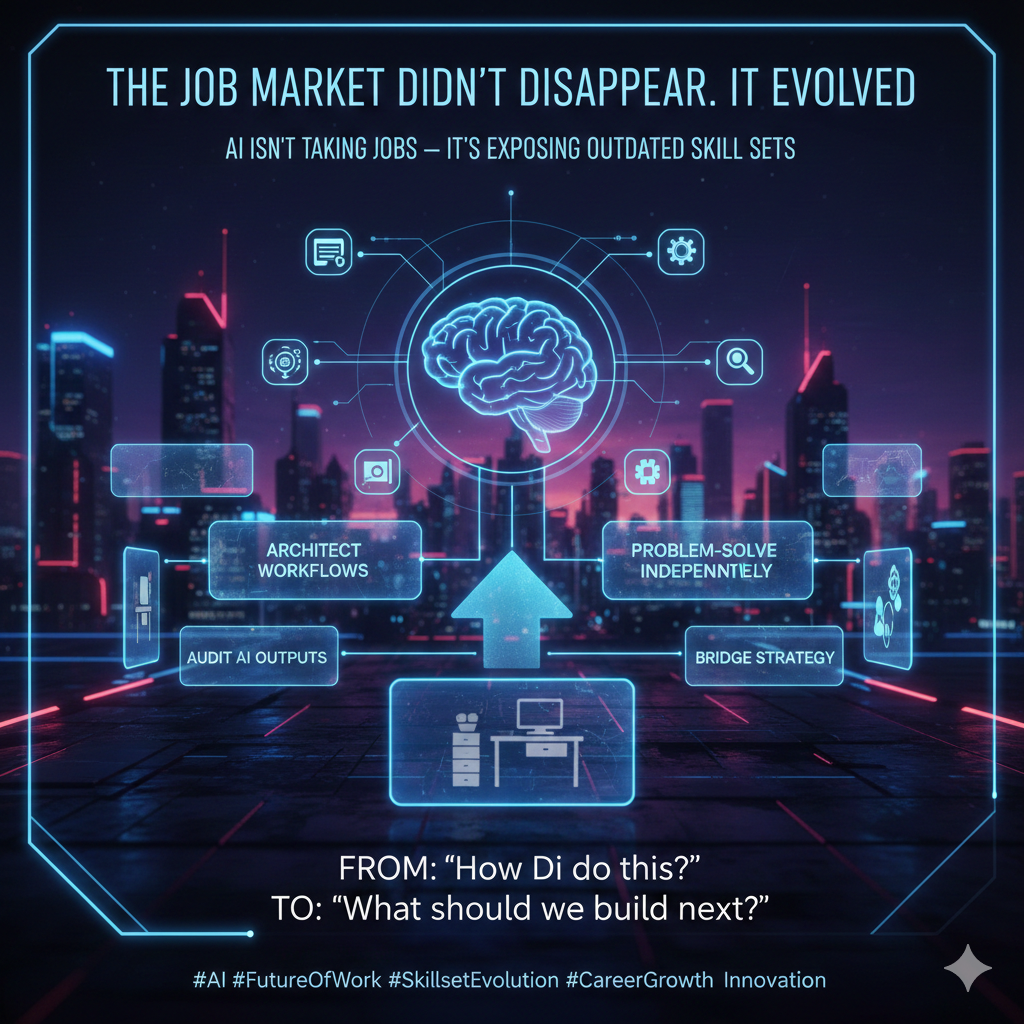
How AI Is Redefining Work, Talent, and the New Rules of Economic Survival
Introduction: The Panic Is Loud. The Truth Is Quiet.
Every few decades, society panics about work.
Factories were supposed to end jobs.
Computers were supposed to end jobs.
The internet was supposed to end jobs.
Now it’s AI.
Scroll LinkedIn, X, or YouTube and you’ll see the same headline repeated in different fonts:
“AI Is Replacing Workers”
“Jobs Are Disappearing”
“Degrees Are Worthless”
“The Workforce Is Finished”
But beneath the noise is a quieter, more uncomfortable truth:
The job market didn’t disappear.
It changed—fast.
AI isn’t destroying opportunity.
It’s exposing who was never positioned to survive change in the first place.
This isn’t a collapse.
It’s a restructuring.
And like every restructuring in history, some people will be promoted…
Others will be eliminated—not by machines, but by relevance.
1. AI Isn’t Taking Jobs — It’s Taking Excuses
Let’s get something straight:
AI is not walking into offices firing people.
Executives are.
And they’re doing it for one reason: efficiency finally has teeth.
For decades, companies carried:
• Redundant roles
• Bloated middle management
• Inefficient workflows
• Employees who looked busy but produced little
AI didn’t create this problem.
It revealed it.
When a single analyst can now do the work of five using AI tools…
When one marketer can produce, test, and optimize campaigns in hours instead of weeks…
When a legal researcher can draft, summarize, and analyze cases in minutes…
The question becomes uncomfortable:
Why are we paying for inefficiency?
AI didn’t eliminate jobs.
It eliminated deniability.
2. The Real Divide: Leverage vs. Labor
The modern workforce is splitting into two categories:
Group One: Labor-Dependent Workers
These workers rely on:
• Time spent
• Tasks assigned
• Linear effort
• Permission to act
Their value is tied to hours, not outcomes.
AI threatens this group because AI compresses time.
Group Two: Leverage-Based Professionals
These workers:
• Use tools to multiply output
• Think in systems, not tasks
• Solve problems, not check boxes
• Produce outcomes, not activity
AI empowers this group because AI amplifies intelligence.
This is the real shift happening in the job market.
Not human vs. machine.
But low leverage vs. high leverage humans.
3. Why Degrees Are Losing Power (But Skills Aren’t)
For decades, the formula was simple:
Degree → Job → Career → Retirement
That formula is broken.
Not because education is useless—but because static knowledge can’t compete with dynamic tools.
AI can:
• Recall information instantly
• Analyze patterns faster than humans
• Summarize complex material in seconds
What AI cannot do well (yet) is:
• Strategic judgment
• Ethical reasoning
• Contextual decision-making
• Leadership under uncertainty
The market no longer rewards what you know.
It rewards what you can do with what you know.
A degree without adaptability is now a liability.
4. The Rise of the “AI-Enhanced Human”
The most valuable worker in today’s market isn’t the smartest person in the room.
It’s the person who knows how to think with machines.
AI-enhanced professionals:
• Use AI to draft, then refine
• Use AI to research, then challenge
• Use AI to brainstorm, then execute
• Use AI to automate, then scale
They don’t fear replacement because they’ve already integrated AI into their workflow.
They are not competing against AI.
They are competing with AI on their side.
And that changes everything.
5. Why Job Descriptions Are Becoming Fiction
If you’ve applied for jobs recently, you’ve probably noticed something strange:
Job descriptions that ask for:
• 10 years of experience in tools that are 3 years old
• Unrealistic skill combinations
• Responsibilities that belong to three different roles
This isn’t incompetence.
It’s confusion.
Companies are struggling to define what roles should look like in an AI-driven environment.
The winning candidates aren’t the ones who check every box.
They’re the ones who walk into interviews and say:
“Here’s how I’d solve your problem—faster, cheaper, and better—using AI.”
6. The Death of “Waiting to Be Trained”
Here’s a harsh truth:
Companies no longer want to train you from scratch.
Not because they’re cruel—but because change is happening too fast.
Training cycles that once took months are now obsolete in weeks.
The new expectation is brutal but clear:
You are responsible for your own relevance.
That means:
• Learning tools on your own time
• Experimenting without permission
• Upskilling continuously
• Staying ahead of the curve
AI rewards the curious and punishes the complacent.
7. Productivity Is the New Resume
Resumes are becoming less important than proof of output.
Hiring managers now care more about:
• What you’ve built
• What you’ve automated
• What you’ve improved
• What results you’ve delivered
AI allows individuals to show, not tell.
Portfolios > Credentials
Case studies > Job titles
Execution > Experience
8. The Psychological Shift: Identity Crisis at Work
Many people aren’t afraid of AI.
They’re afraid of losing identity.
For years, work provided:
• Status
• Structure
• Validation
• Purpose
AI disrupts that.
When tasks you built your identity around become automated, the question becomes existential:
Who am I if this isn’t needed anymore?
The answer isn’t to resist change.
It’s to rebuild identity around adaptability.
9. Entrepreneurs Aren’t Immune — They’re Just Exposed Faster
Entrepreneurs love to say, “AI won’t replace business owners.”
That’s half true.
AI won’t replace owners.
But it will replace lazy operators.
Businesses that fail to:
• Automate operations
• Use AI for marketing and sales
• Optimize customer experience
• Reduce overhead
Will be outperformed by smaller, smarter competitors.
AI lowers the barrier to entry—while raising the bar for survival.
10. The New Career Question Everyone Must Answer
The old question was:
“What do you do?”
The new question is:
“What do you improve?”
If you can clearly articulate:
• What problems you solve
• How you use AI to solve them better
• Why your judgment matters
You will not be unemployed for long.
If you cannot—no degree, certification, or title will save you.
11. Adaptation Is No Longer Optional — It’s a Moral Obligation
In previous generations, adaptation was a competitive advantage.
Today, it’s table stakes.
The people who suffer most in economic transitions aren’t the unlucky.
They’re the unprepared.
And preparation is a choice.
12. The Winners of the AI Era Share These Traits
Across industries, the people thriving right now share common traits:
• They learn fast
• They experiment often
• They aren’t emotionally attached to old methods
• They focus on leverage, not effort
• They think in systems
• They act before certainty
They don’t wait for permission.
They build.
Conclusion: The Future Belongs to the Adaptable
AI is not the villain of the modern job market.
Stagnation is.
This moment will separate:
• Workers from value creators
• Task-doers from problem-solvers
• The comfortable from the courageous
The job market didn’t disappear.
It issued a challenge.
And the only real question left is:
Will you adapt early—or compete forever?