
How Frank Lewis Positioned MBQ Magazine at the Center of Wealth and Economic Influence
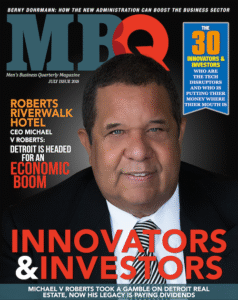
From Media Platform to Movement, the Publisher Behind MBQ Is Building Stages Where Power Is Recognized and Legacy Is Cemented.
In an era where financial literacy is more urgent than ever and economic access remains uneven, platforms that educate, convene, and empower carry extraordinary weight. For Frank Lewis, building such a platform was never accidental — it was intentional.
As Founder and Publisher of Men’s Business Quarterly (MBQ Magazine), Lewis didn’t simply launch another business publication. He engineered a wealth-centered ecosystem — one designed to elevate financial intelligence, celebrate economic leadership, and create structured rooms where capital, culture, and influence converge.
MBQ’s rise was not viral.
It was strategic.
And today, the magazine stands at the center of conversations around wealth education, economic empowerment, and leadership visibility.
From Publication to Wealth Platform
When MBQ Magazine was launched, the goal was clear: speak directly to ambitious professionals who wanted more than motivation — they wanted strategy.
The publication blended:
-
Business formation and capital access
-
Credit strategy and financial literacy
-
Investing and asset-building
-
Executive lifestyle and leadership development
-
Cultural intelligence tied to economic progress
But what separated MBQ from traditional media was its orientation toward application. Articles weren’t written merely to inspire — they were designed to equip.
Lewis understood something foundational:
Financial empowerment requires infrastructure.
Education must be consistent.
Recognition must be structured.
Rooms must be curated.
MBQ became the delivery system for all three.
The Rooms Where Wealth Conversations Happen
Over time, Lewis built proximity to leaders across sports, finance, faith, government, media, and entrepreneurship — reflecting an ecosystem where wealth creation intersects with influence.
His documented engagements include moments alongside:
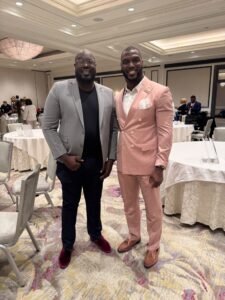
- Orson Prince-Charles, NFL Veteran & Entrepreneur
-
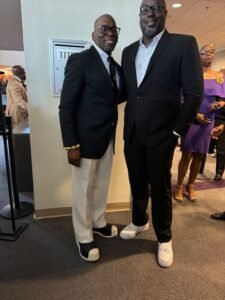
Pastor Jamal Harrison Bryant, Senior Pastor of New Birth Missionary Baptist Church
-
Dr. Michael V. Roberts, Chairman & CEO of The Roberts Companies

-
Isaac Hayes III, Technology Founder & Creator of Fanbase

Rashad Richey, Nationally Syndicated Political Commentato
-
Miguel Wilson, International Fashion Icon & Luxury Menswear Designer

-
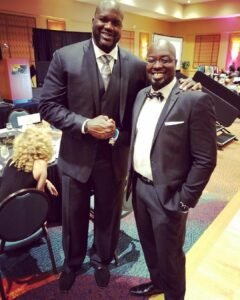
Shaquille O’Neal, NBA Hall of Famer & Global Investor
-
Ray Lewis, NFL Hall of Famer & Leadership Mentor

-
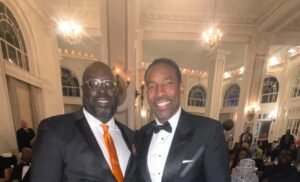
2 Chainz (Tauheed Epps), Grammy Award-Winning Artist & Entrepreneur

- Andre Dickens, Mayor of Atlanta
-
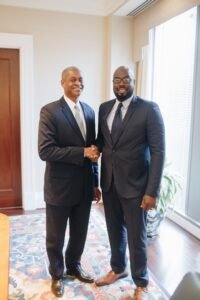
Raphael Bostic, President & CEO of the Federal Reserve Bank of Atlanta
These intersections reflect a key thesis: wealth education does not operate in isolation. It intersects with policy, culture, entertainment, athletics, and faith leadership.
MBQ formalized those intersections into a structured platform.
The Economic Influencer Awards: Validating Impact
One of the defining moments in MBQ’s evolution was the launch of the MBQ Economic Influencer Awards Gala.
Hosted in Atlanta at premier venues including The Ritz-Carlton, the gala was created to recognize leaders whose economic impact is measurable — not simply visible.
Honorees were evaluated on:
-
Capital deployment
-
Enterprise growth
-
Community investment
-
Policy impact
-
Job creation
By anchoring recognition in measurable economic footprint, Lewis elevated MBQ beyond media into institutional validation.
The awards did more than celebrate achievement — they reinforced the importance of structured wealth creation.
Expanding the Vision: The Iconic Men Awards
Building on that momentum, MBQ introduced the Iconic Men Awards, expanding recognition to leadership, character, enterprise scale, and legacy impact.
The event gathered entrepreneurs, executives, policymakers, athletes, and faith leaders under one unified platform — reinforcing MBQ’s position not just as a magazine, but as a convening authority.
In doing so, Lewis demonstrated that financial empowerment requires both education and recognition.
You must teach wealth.
You must celebrate wealth builders.
And you must connect them.
Strategic Proximity: Why It Matters
In business, proximity shapes perspective.
Exposure to professional athletes turned investors, developers shaping urban skylines, policymakers guiding municipal growth, Federal Reserve leadership influencing monetary direction, and cultural entrepreneurs redefining ownership models provides something more than visibility — it provides context.
Lewis’s engagements reflect a systems-level understanding of economic influence:
-
Sports evolves into ownership and equity stakes.
-
Faith communities become economic mobilization centers.
-
City leadership determines development pipelines.
-
Federal monetary policy shapes cost of capital.
-
Tech innovation shifts platform ownership.
-
Fashion builds brand equity and generational wealth narratives.
MBQ sits at the intersection of these conversations.
Not as a spectator — but as a platform.
The Lewis Enterprise Model
Behind the magazine is a diversified business infrastructure spanning media production, technology integration, real estate, construction, and financial strategy. At one point, Lewis Finch Studios became one of the largest Black-owned film studios in DeKalb County, Georgia, reinforcing Lewis’s long-held belief that controlling narrative infrastructure is economic leverage.
MBQ functions as the visibility engine within that broader ecosystem.
Media builds credibility.
Events build relationships.
Education builds capability.
Recognition builds legitimacy.
Together, they build wealth ecosystems.
Financial Empowerment — Intentionally Built
What makes MBQ distinct is its intentionality.
Financial empowerment is not treated as a slogan — it is designed into the architecture:
-
Articles centered on strategy, not hype
-
Award platforms centered on measurable impact
-
Rooms curated across industries
-
Visibility aligned with economic contribution
Lewis did not chase virality.
He built infrastructure.
And in doing so, he positioned MBQ Magazine at the center of wealth education and economic influence.
In a time where conversations about generational wealth are increasing, MBQ’s presence represents something critical: a structured, strategic platform built to sustain those conversations long-term.
Not by accident.
But by design.