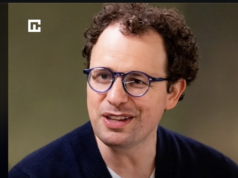
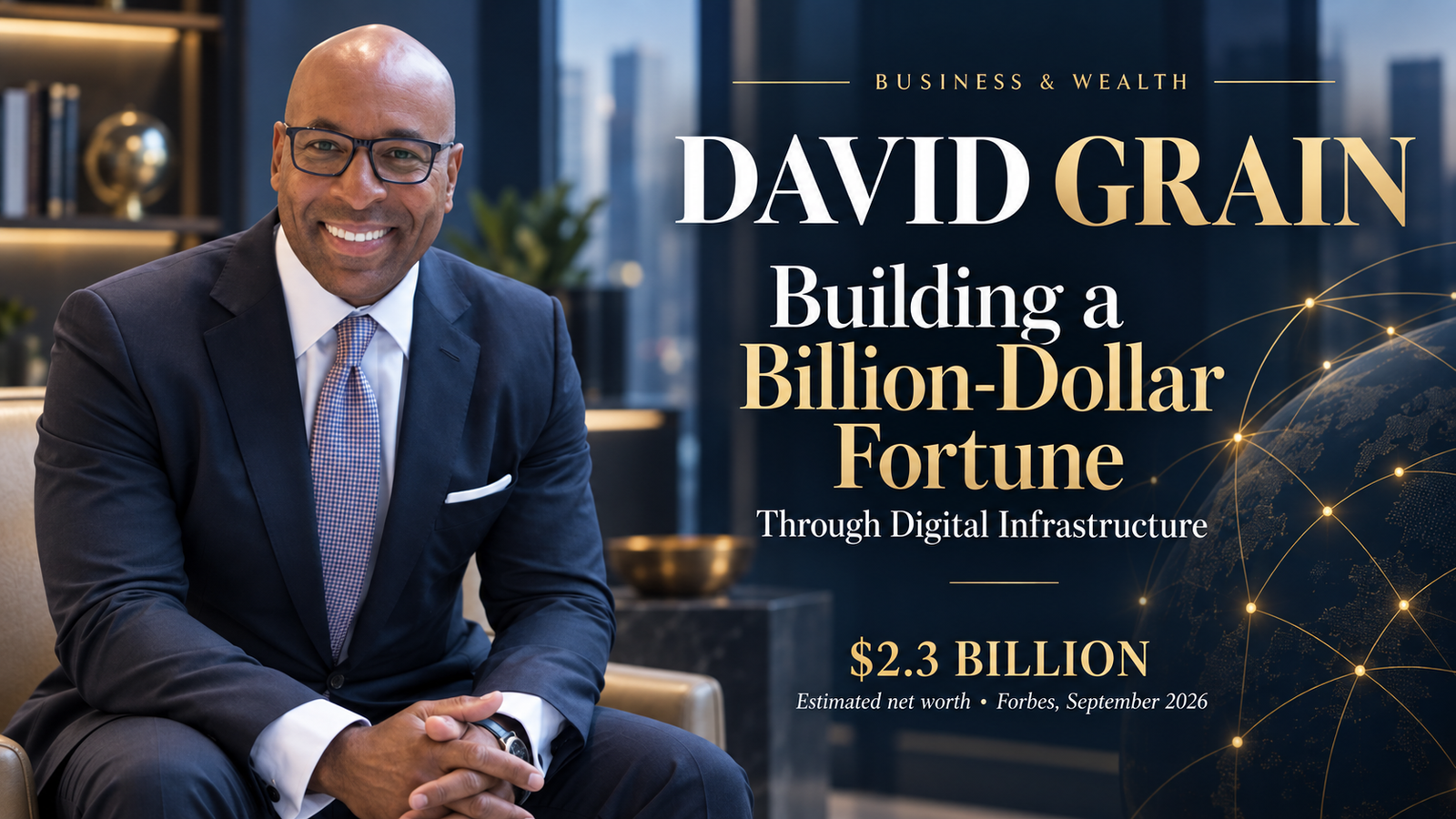
David Grain, founder and CEO of Grain Management, is among the world’s billionaires, with Forbes estimating his net worth at $2.3 billion as of September 17, 2026. His success highlights the wealth-building potential of investing in the infrastructure that keeps people and businesses connected. Forbes
The founder of Grain Management has built a career investing in the networks that keep businesses, communities and the digital economy connected.
Every video call, online transaction and digital service depends on infrastructure that most people rarely see. Beneath the convenience of modern technology are communications networks that require capital, expertise and yea
rs of development.
David Grain built his business around that essential need.
The founder and CEO of Grain Management has an estimated net worth of $2.3 billion as of September 17, 2026, according to Forbes. His position among the world’s billionaires reflects a career spanning finance, telecommunications leadership and private investment. Forbes
The number attracts attention, but the career behind it deserves a closer look. Grain’s story demonstrates how specialized knowledge can become the foundation for business ownership—and how the infrastructure supporting everyday technology can create substantial economic value.
A Foundation in Finance and Operations
Grain’s education did not begin with an engineering degree. He earned a bachelor’s degree in English from the College of the Holy Cross before completing an MBA at Dartmouth’s Tuck School of Business. His professional experience later included serving as an executive director in Morgan Stanley’s High Yield Finance Department and as senior vice president of AT&T Broadband’s New England Region. Grain Management biography
Those positions exposed him to two closely connected disciplines: financing businesses and operating them. An investor must understand the numbers, while an operator must understand the customers, employees and systems that produce those numbers.
That combination provides a useful lens for understanding Grain’s subsequent career. His experience gave him opportunities to evaluate communications businesses from both financial and operational perspectives.
One of his most significant leadership assignments was at Pinnacle Towers, later renamed Global Signal. According to his company biography, Grain led the wireless communications tower business from bankruptcy through a successful initial public offering, helping develop it into a major independent tower company. Grain Management biography
The experience preceded the launch of Grain Management in 2007 and helped establish the industry background on which his investment business would be built.
Investing in the Foundations of Connectivity
Grain Management focuses on digital infrastructure. Its stated investment areas include fiber networks, data centers, wireless spectrum, cell towers, and managed and infrastructure services. The firm describes its approach as combining sector knowledge, operating experience and disciplined financial analysis. Grain Management
These assets perform different functions, but they belong to the same larger system: the infrastructure through which people and organizations exchange information.
For readers unfamiliar with the industry, the central business idea is straightforward. Digital services need dependable networks, and those networks need investors and operators capable of building, maintaining and improving them.
Grain’s career suggests that understanding this underlying demand can reveal opportunities beyond the consumer products that receive most of the attention. The investment thesis rests on the usefulness of connectivity and the assets required to deliver it.
An Investment Reaching Into the Arctic
In February 2024, Grain Management announced that it had completed its acquisition of Quintillion, a provider of fiber-based connectivity in Alaska and the North American Arctic.
Quintillion operates subsea and terrestrial fiber infrastructure and provides broadband connectivity, satellite ground station and edge processing services. Its customers include government and commercial telecommunications providers. Quintillion acquisition announcement
The deal offers a concrete example of the firm’s focus. In geographically challenging regions, reliable communications depend on substantial physical infrastructure. An investment in that infrastructure involves understanding both the network itself and the organizations that need its services.
Viewed through that lens, the Quintillion acquisition illustrates how digital infrastructure investing can connect commercial opportunities with practical communications needs.
Wireless Spectrum and Essential Services
Another example emerged in March 2025, when Grain Management announced an arrangement to acquire T-Mobile’s 800 MHz spectrum portfolio. At the time of the announcement, the proposed transaction remained subject to regulatory approvals and closing conditions.
The firm outlined plans to make the spectrum available to U.S. utilities for private communications networks supporting grid operations, resilience and emergency response. Black & Veatch was named as an industry partner to help facilitate utility participation and implementation. Spectrum transaction announcement
The announcement broadened the picture of what connectivity can mean as a business opportunity. Communications infrastructure supports essential industrial functions as well as household internet access.
Taken together, the firm’s fiber and spectrum activities suggest a consistent approach: identify situations where reliable connectivity matters, then invest in assets positioned to serve that need. That is an interpretation of its investment activity, rather than a promise of future returns.
A Commitment to Educational Opportunity
Grain’s public record also includes support for students. According to Forbes, he and his wife established the Grain Fellows Program in 2004 to assist students from low-income households at Booker High School in Sarasota, Florida.
The program has supported SAT and college preparation, application fees and mentorship. Those efforts address practical barriers that can stand between a student’s ambition and access to higher education. Forbes
This part of his story adds another dimension to the billionaire headline: a record of educational support that began before he founded Grain Management.
What Entrepreneurs Can Learn From His Career
For entrepreneurs, Grain’s progression offers several lessons worth considering.
The first is the value of industry expertise. His investment business followed years of experience in finance and telecommunications. That sequence suggests the importance of learning how an industry works before trying to build a major ownership position within it.
The second is the connection between operating skill and investment judgment. Understanding a company’s financial statements is useful; understanding what makes its services reliable, competitive and valuable can deepen that assessment.
The third is the importance of distinguishing personal wealth from investment capital. Forbes’ estimate concerns Grain’s personal net worth. It should not be confused with the money his firm manages or the total value of assets held through its investment vehicles.
Grain’s $2.3 billion valuation marks a substantial business achievement. His broader story is about the accumulation of expertise, the transition into ownership and the ability to recognize value in essential systems.
As technology becomes more deeply embedded in daily life, his career directs attention toward the networks beneath it—and toward the business opportunities available to people who understand how those networks work.