
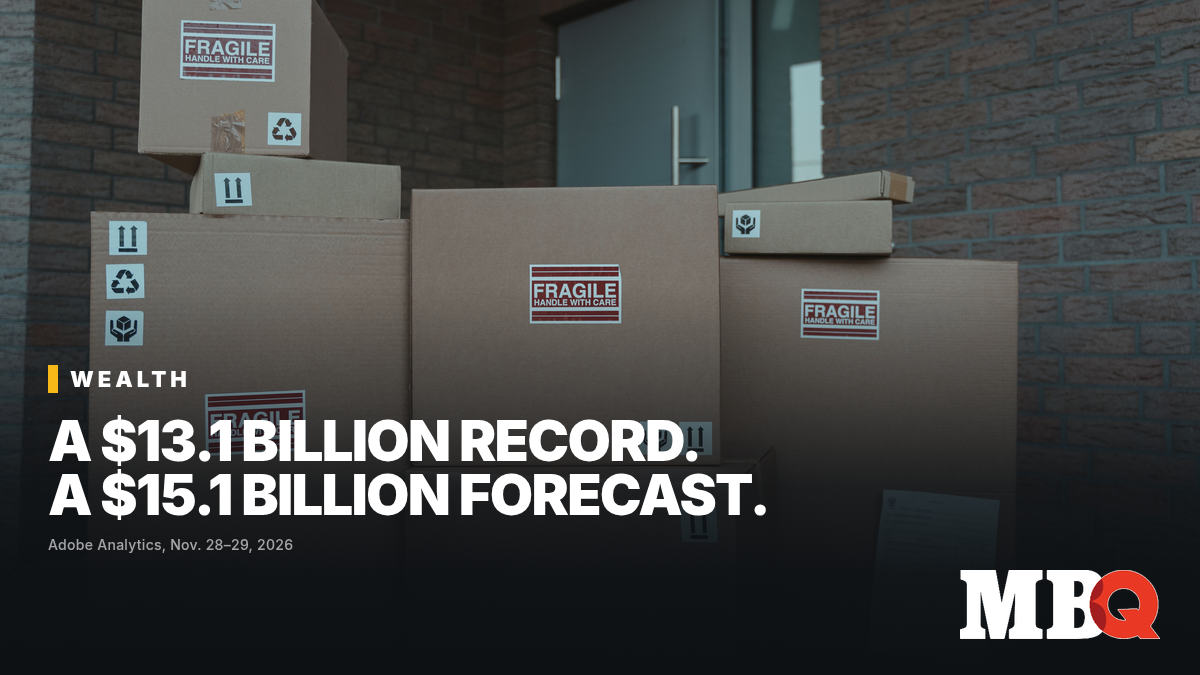
Adobe’s $13.1 billion Black Friday actual beat its forecast. Cyber Monday is projected to be the first $15 billion online day.
The receipt is in. U.S. consumers spent $13.1 billion online on Black Friday, Nov. 27, according to Adobe Analytics. Adobe’s holiday-report page lists that total as 11.1% higher than a year earlier. Reuters and the Associated Press, in weekend recaps, rounded the gain to 11%. Either way, the day beat Adobe’s earlier forecast of about $12.9 billion, Reuters reported.
The AP and The Washington Post described the Black Friday figure as preliminary. Adobe’s key-dates table already lists the $13.1 billion actual, alongside $7.1 billion online on Thanksgiving.
Cyber Monday, Nov. 30, is built to top it. Adobe expects $15.1 billion in U.S. online spending, up 6.2% from last year — which would be the first single day to eclipse $15 billion, the firm says, as The Washington Post also reported. Across the five-day Thanksgiving-to-Cyber-Monday window, Adobe expects about $47.5 billion online, Reuters reported, citing the company’s data.
The click got stronger. The aisle got quieter.
The online record did not come with a matching rush at the door. Foot traffic at U.S. stores was down 2.2% from a year earlier, at nearly 930 million visits on Black Friday, according to PassBy, a geospatial analytics firm cited by Reuters. The AP, reporting Saturday, said fewer people shopped in person that day.
That does not mean the physical store went dark. Mastercard SpendingPulse, which tracks payments including cash and excludes gasoline and automobiles, found that retail sales in stores and online were up 5.8% from last year’s Black Friday, the AP reported. That comparison is not adjusted for inflation. Mastercard said e-commerce spending rose 13.4% and in-store spending rose 3.8%, which it called the strongest Black Friday for in-store sales since 2022. Online grew faster. The softer in-store number was visits, not dollars. If you are building wealth, that split is the tell: the holiday is now a week of screens as much as a Friday in a parking lot. The bill arrives the same way.
What actually moved
Adobe told Reuters that electronics and gaming were among the strongest-selling categories, with discounts and promotions on apparel and appliances helping the total clear the forecast. Shoppers also used those discounts to stock up on everyday essentials — cleaning supplies, pet care and personal hygiene — the Adobe report said, as Reuters noted. Reuters, in the same recap, said inflation was running at 3.8%. That matches the personal-consumption-expenditures price index for the 12 months through October, which Reuters reported on Nov. 25.
A record online day was not only a gadget story. It was also a staples story. Buying soap and pet food on a sale calendar can be rational. It is also how a weekend bill grows from gifts you planned to a cart you did not. The same trap shows up in style: a deeper markdown on a jacket you already meant to buy is one thing. A cart that fills because the calendar says “Monday” is how a wardrobe gets expensive without getting better.
The $1.09 billion question
Adobe expects buy now, pay later to contribute $1.09 billion in online spending on Cyber Monday, up 5.3% from a year earlier, Reuters reported, citing Adobe Analytics. That is not a hack, and it is not free money. It is a way of spreading a charge — and a charge that is still a charge. A man building wealth, style and a legacy does not measure the weekend by how much he can postpone. He measures it by what he still owns, and what he still owes, on Tuesday morning. If a planned purchase is cheaper on Monday and can be paid without carrying a balance, the calendar can work in your favor. If the installment is what makes the cart feel painless, the sale is doing the selling, not you.
What to take into Monday
A few educational points, not a plan for any one reader:
-
Know the regular price before you praise the sale. Adobe beat a forecast because promotions were working. That does not tell you whether a given item is cheaper than it was last month. Check the ordinary-week price first.
-
Write the list before the tab is open. Gifts, a coat, a laptop — and essentials — can all be planned. The record $13.1 billion includes both, and the second category is where a weekend bill grows without feeling like a splurge.
-
Treat buy now, pay later as debt, because it is. The $1.09 billion Adobe expects on Monday will look like convenience at checkout. Count the payments as you would any other obligation.
-
Set a ceiling for the five-day window, not a mood. Adobe’s $47.5 billion outlook treats the weekend as one event. Your version of that number is a cap you choose before Monday, not a total you discover in December.
-
Remember the store is still a tool. Traffic was lighter, not gone. If you can compare a price in person and still pay in a way that does not roll into next month, use the channel that leaves the balance sheet cleaner.
Cyber Monday will be sold as a once-a-year opening. The more useful frame is simpler: a record Friday already happened, Monday is forecast to go larger, and the people who come out ahead will have decided, in advance, what a good buy is worth.
This article is for educational purposes only and is not investment, tax, legal or personalized financial advice. MBQ Magazine does not recommend buying or selling any security, product or credit product. Consult a qualified financial professional about your situation.
Photo: Tima Miroshnichenko / Pexels (https://www.pexels.com/photo/brown-boxes-at-the-doorway-6169014/)
Sources
- Adobe, “2026 Holiday Shopping Trends: Actuals,” including the key-dates table. Black Friday listed at $13.1 billion, up 11.1% year over year; Cyber Monday expected at $15.1 billion, up 6.2%, projected as the first single day to eclipse $15 billion in U.S. online spending; Thanksgiving listed at $7.1 billion. Holiday report; key-dates table.
- Reuters, “US Black Friday online spend rises 11% to a new high of $13.1 billion,” by Juveria Tabassum and Waylon Cunningham, Nov. 28, 2026, as carried by Investing.com. Confirms the $13.1 billion total, an 11% gain, a beaten forecast of about $12.9 billion, the $15.1 billion Cyber Monday outlook (up 6.2%), about $47.5 billion across the five-day window, $1.09 billion in expected Cyber Monday buy-now-pay-later spend (up 5.3%), electronics and gaming as strong categories, essentials restocking, inflation running at 3.8%, and PassBy foot traffic of nearly 930 million visits, down 2.2%.
- Associated Press, “US shoppers spent billions on Black Friday while seeking wide-ranging deals”. Reports a record online Black Friday, the $13.1 billion Adobe total as exceeding its forecast and up 11%, fewer in-person shoppers, and Mastercard SpendingPulse’s 5.8% rise in store-and-online retail sales, excluding gasoline and automobiles.
- Mastercard, “Black Friday 2026 U.S. retail sales rise 5.8%”, Nov. 28, 2026. Mastercard SpendingPulse, preliminary, not adjusted for inflation, measures in-store and online retail sales and all payment types, excluding gas and autos: total retail sales up 5.8% from Black Friday 2025; e-commerce spending up 13.4%; in-store spending up 3.8%, “the strongest Black Friday for in-store since 2022.”
- The Washington Post, Taz Ali, Nov. 29, 2026. Reports $13.1 billion online, an 11.1% increase, and Adobe’s $15.1 billion Cyber Monday forecast, up 6.2%, as the first time U.S. online spending would exceed $15 billion in a single day; describes the Black Friday data as preliminary.
- Fox Business, Michael Sinkewicz, Nov. 28, 2026, with Reuters contributing. Recaps the same Adobe and PassBy figures reported by Reuters.