
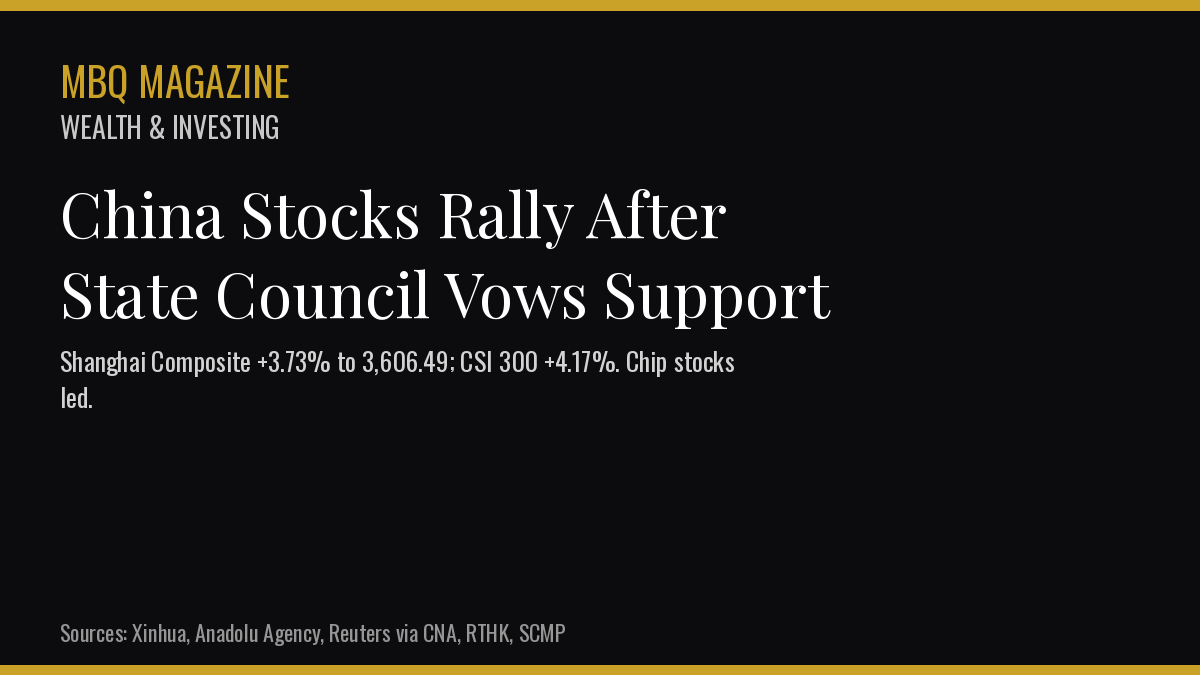
Chinese chip stocks surged after a cabinet meeting in Beijing. For investors with China in their funds, the lesson is who sets the rules.
China’s stock market had its best day in more than two years on Friday, Nov. 27, and the move came after a government meeting, not an earnings report or economic data release.
After a State Council meeting chaired by Premier Li Qiang called for stronger support for the stock market, the benchmark Shanghai Composite Index closed 3.73% higher at 3,606.49, according to China’s state news agency Xinhua. The blue-chip CSI 300 Index rose 4.17% to 4,063.06, Anadolu Agency reported. Both indexes posted their biggest daily gains since October 2024, when China rolled out large stimulus measures, according to Reuters, in a report published by CNA. (Reuters’ initial report gave the Shanghai Composite’s gain as 4.2% and the CSI 300’s as 3.7%; exchange-based figures show 3.73% and 4.17%.)
The China stocks rally after the State Council’s pledge was strongest in technology. Xinhua said the STAR Composite Index, which tracks Shanghai’s tech-focused board, jumped 14.21%, with semiconductor and electronics stocks leading. Reuters reported that the STAR 50 index rose 15%, its largest one-day jump in two years, and that the CSI Semiconductor Industry Index and STAR Chip Index each rose more than 17%. In Hong Kong, the Hang Seng gained 1.9% and the Hang Seng Tech Index 6%.
What Beijing promised
The cabinet said capital markets are vital to the broader economy, Xinhua reported. Its statement called for:
- Improving “market-stabilizing mechanisms” and considering new measures, which the South China Morning Post described as planning incremental policies.
- Encouraging listed companies to pay more dividends and buy back more shares.
- Giving a larger role to state-backed funds in steadying the market, and strengthening the role of Central Huijin Investment, a state-owned investor, as a quasi-“stabilization fund” to provide liquidity.
- Improving policies to guide medium- and long-term money, such as insurance funds, enterprise annuities and social security funds, into stocks, and strengthening defenses against “imported” risks from overseas markets, Xinhua reported.
The move came after Chinese shares had fallen to 16-month lows amid worries about weak consumer demand, a long property slump and trade tensions, Reuters reported. Regulators had already eased margin-lending rules and cut trading fees the previous weekend.
“Sentiment has been downbeat for so long. … At least now there’s something to count on: the national team will come to the rescue if things really turn south,” Kenny Ng, a strategist at China Everbright Securities International, told Reuters.
A different playbook
The “national team” is the market’s nickname for state-backed investors, usually led by Central Huijin, which are often buyers at times of market stress, according to RTHK. The cabinet also called for policies to guide long-term funds into the market. Some investors read a statement like Friday’s as a signal that such buyers could step in.
That is a different arrangement from the one most U.S. investors are used to, where the government sets rules and the Federal Reserve sets interest rates, but prices are driven mostly by private buyers and sellers. Neither system is free of risk. China’s simply adds a layer: policy can lift prices in an afternoon, and policy can change just as quickly.
Not everyone is convinced the bounce will last. “I would distinguish between a turning point in policy resolve and a turning point in market fundamentals … A policy-induced bounce needs to evolve into a fundamentally driven recovery before we can confidently call it a durable bottom,” said Charu Chanana, chief investment strategist at Saxo Bank, according to Reuters.
The AI race angle
The biggest winners were chipmakers and companies tied to AI infrastructure. Xinhua said shares linked to high-bandwidth memory and co-packaged optics, both key ingredients in AI data centers, posted strong gains, as did stocks tied to China’s national semiconductor fund. Reuters reported that indexes tracking China’s AI and cloud-computing stocks jumped more than 10%. Not every sector rose: Xinhua noted that banking shares were among the laggards.
What a U.S. investor should understand
Many Americans own Chinese stocks without picking them, through emerging-market or international funds. If that’s you:
- Know your exposure. Check what share of your international or emerging-market fund is in China and in Chinese tech.
- Expect bigger swings. A 14% one-day move in an index cuts both ways. Policy-driven rallies can reverse.
- Policy risk is part of this market. A government statement can move prices as much as a company’s earnings, as Friday showed.
- One day isn’t a trend. Analysts quoted by Reuters said a policy-induced bounce still has to turn into a fundamentally driven recovery before it can be called durable.
This article is for informational and educational purposes only and is not investment advice. MBQ Magazine does not recommend buying or selling any security or fund. Consult a qualified financial professional about your situation.