
On Tuesday night, Georgia did something it has never done in its history — and something America has never done either.
The Associated Press called the governor’s race for Keisha Lance Bottoms, who defeated Republican Rick Jackson with about 55 percent of the vote. Bottoms becomes the first Black governor of Georgia, the first woman governor of Georgia, and the first Black woman ever elected governor in the United States. She succeeds term-limited Governor Brian Kemp, takes office in January, and returns the governor’s mansion to Democrats for the first time since Roy Barnes left office in January 2003.
Those are the headlines. The more important question for Black Georgia is the one underneath them: what does this actually change?
A line that runs from 1974 to Tuesday night
Bottoms’ victory did not start with her campaign. It started in 1974, when Maynard Jackson took the oath as Atlanta’s first Black mayor — the first Black mayor of any major city in the South. Jackson understood something that still defines Atlanta: political power is only real when it moves money. Under his administration, the share of city business going to minority firms rose from less than 1 percent to more than 35 percent. An airport, contracts, and a generation of Black business followed.
Atlanta has been led by Black mayors ever since — Andrew Young, Bill Campbell, Shirley Franklin, Kasim Reed, and Andre Dickens today. Keisha Lance Bottoms was the city’s 60th mayor, serving from January 2018 to January 2022, after representing Southwest Atlanta on the City Council. Her win on Tuesday makes her the first former Atlanta mayor ever elected to Georgia’s highest office.
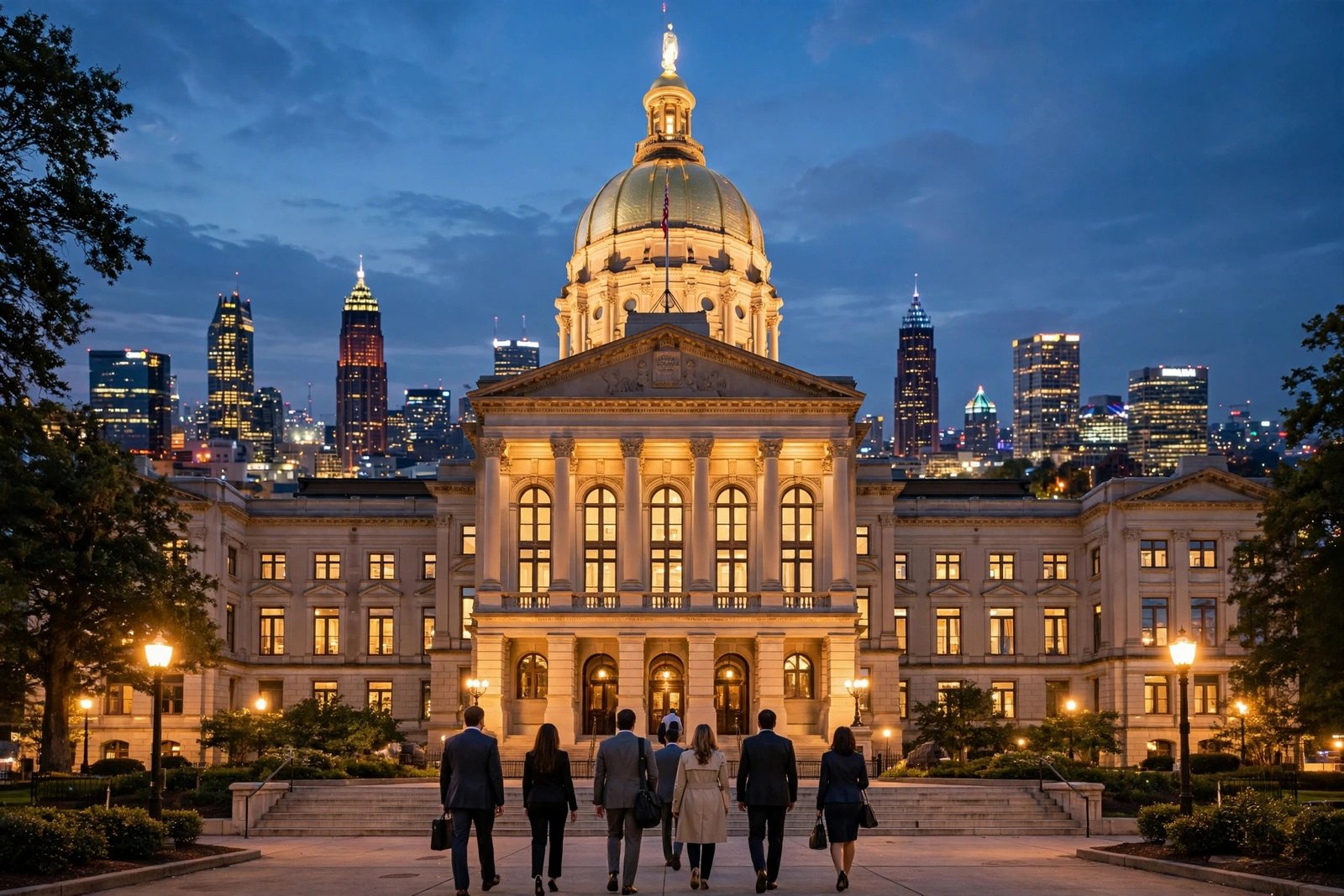
For decades, the arrangement in Georgia was understood: Black leadership ran the city, from City Hall on Trinity Avenue. State power, a few blocks away under the Gold Dome, belonged to someone else. Tuesday night, that arrangement ended.
It also finished a run that Stacey Abrams started. Georgia Democrats nominated a Black woman for governor three straight times — Abrams in 2018, when she lost to Kemp by about a point, and again in 2022. Bottoms is the one who closed it.
What a governor actually controls
A governorship is not a ceremonial seat, and for Black business in Georgia, the levers matter as much as the symbolism:
- The budget. The governor proposes the state budget and signs it. That decides what gets built, funded, and staffed across Georgia — from roads and ports to schools and hospitals.
- Appointments. The governor fills seats on the boards and authorities that run much of the state’s business — economic development, transportation, the university system, and dozens of agencies. Who sits in those rooms shapes who gets heard.
- Contracts and development. The state is one of the largest buyers in Georgia. The governor sets the tone for state contracting and leads the recruitment of the factories, studios, and headquarters that bring jobs with them.
- The veto. Nothing becomes law in Georgia without surviving the governor’s desk.
Maynard Jackson proved at the city level that a chief executive who treats access to contracts as a priority can change who participates in an economy. The open question — the real story of the next four years — is what that same philosophy looks like applied to an entire state.
What she ran on
Bottoms campaigned on the cost of living, and her proposals were specific: fully expand Medicaid, which her campaign said would cover about 300,000 more Georgians; fully fund public schools and eliminate the state income tax for teachers; a “Georgia Housing Fast Track” to speed housing permits, plus an affordable housing trust fund; and support for a $15 minimum wage and tuition-free community and technical college.
Those are campaign proposals, not law. She will have to negotiate with a legislature, and some of it will not survive that process. But the direction is clear: her pitch to Georgia was that the economy is measured at the kitchen table, not only in the state’s headline growth numbers.
The honest test
Representation matters. A Black girl in Georgia will now grow up having seen a Black woman run her state — and a Black boy in Atlanta will see that City Hall can be a road to the Gold Dome, not a ceiling. That is not a small thing, and MBQ will not pretend it is.
But this magazine’s standard has never been symbolism alone. It is ownership, health, and wealth, measured in results. So the test of the Bottoms administration for Black Georgia will be written in specifics: Who gets appointed. Who gets the contracts. Whether the housing gets built and who can afford it. Whether the Medicaid expansion happens and what it does for the Black families who run this state’s small businesses without a safety net.
Tuesday night was history. What it means will be decided by what happens next — and we intend to keep score.
Health. Wealth. Self.
Sources: Associated Press race calls and results, Nov. 3, 2026 (Bottoms ~55%); Bottoms served as Atlanta’s 60th mayor, Jan. 2, 2018–Jan. 3, 2022, and is the first former Atlanta mayor elected governor of Georgia (FOX 5 Atlanta; WSJ). Maynard Jackson minority-contract figures (less than 1% to more than 35%) per Black Star News / Britannica. Bottoms campaign proposals per Columbus Times and FOX 5 Atlanta candidate profiles, Oct. 2026 — proposals, not enacted law.