
There are five weeks left in 2026, and the calendar is doing more work than the market narrative. The Federal Reserve’s next policy meeting is December 8–9. The minutes from October, released November 18, show most officials still expect further rate increases. That is the backdrop for year-end investing this season: you are not waiting on a friendly cut. You are deciding, while you still can, how much of this year’s money actually gets invested.
This is not a call to day-trade the December meeting. It is a reminder that some of the highest-return moves available to a working professional are administrative, and they expire. A 401(k) deferral has to come out of 2026 pay. Tax-loss harvesting, if you need it, has to be done by December 31. The IRA can wait until the tax deadline in 2027, but the paycheck contributions cannot.
Year-end investing starts with what the Fed just told you
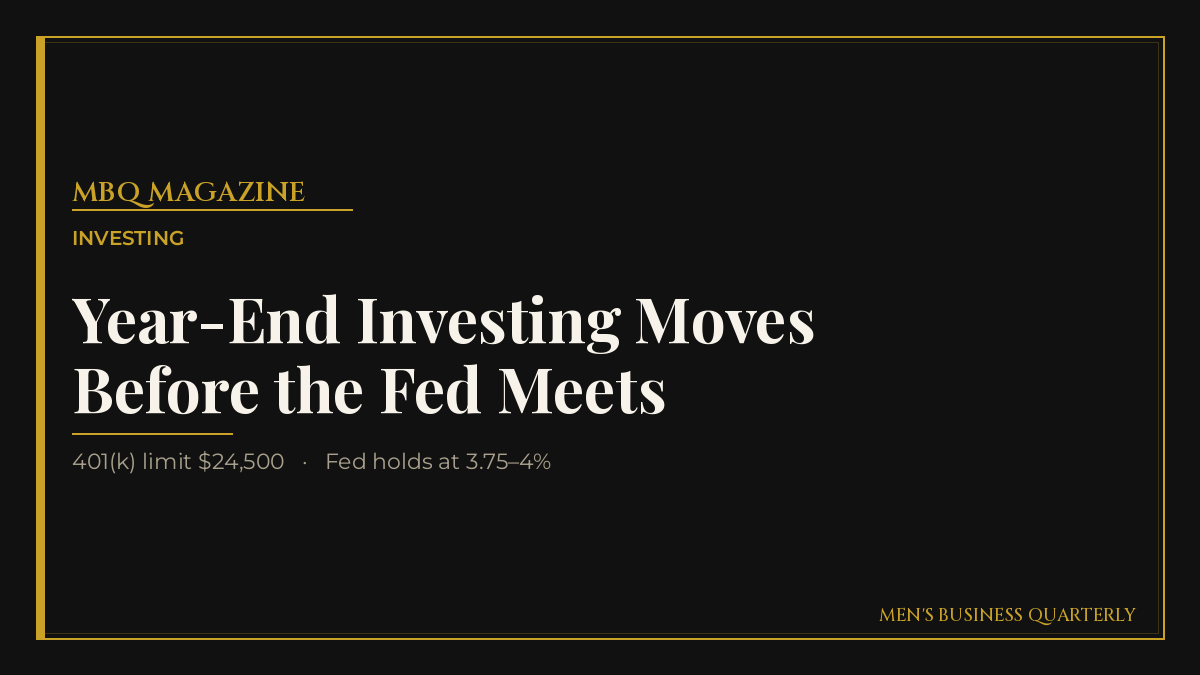
On October 28, the Federal Open Market Committee voted 10–2 to hold the federal funds target range at 3.75% to 4%. Governors Lisa D. Cook and Beth M. Hammack dissented; both wanted a quarter-point increase at that meeting. The statement said economic activity is expanding at a strong pace, job gains have kept up with the workforce, and inflation “remains elevated.”
The minutes fill in the posture. Almost all participants judged that, under their baseline outlooks, further action to raise the target range would likely be appropriate. Some already wanted the hike in October. A few who voted to hold still described the decision as a close call. This is not a committee looking for a reason to ease before year-end.
For a household or a founder, the practical translation is simple. Borrowing is not about to get cheap. Cash will still pay something, but the window to put 2026 earned income into tax-advantaged accounts is closing on a schedule that does not care what the December statement says.
Max the accounts that actually close this year
The Internal Revenue Service set the 2026 employee elective deferral limit for 401(k), 403(b), governmental 457 plans and the Thrift Savings Plan at $24,500. If you are 50 or older, and your plan allows it, the catch-up is $8,000, for a combined $32,500. If you turn 60, 61, 62 or 63 this year, the higher catch-up under SECURE 2.0 is $11,250, for a combined $35,750. The overall annual-additions cap, including employer money, is $72,000, or up to $80,000 with regular catch-up contributions and $83,250 for those ages 60 to 63, according to the IRS 401(k) limit page.
Those deferrals have to come from pay received in 2026. If you are behind, the only lever left is to raise your contribution rate on the remaining paychecks, including a year-end bonus if your plan accepts it. Check the payroll calendar now, not the week of Christmas.
A new rule matters for higher earners. Beginning in 2026, if your plan offers a Roth feature and your prior-year wages with that employer were more than $150,000, catch-up contributions must be made on a Roth basis. That is after-tax money going in, with the usual Roth treatment later. Confirm the setup with your plan administrator; implementation still varies by employer, and getting it wrong in December is an expensive paperwork problem.
The IRA is more forgiving on time and tighter on dollars. The 2026 limit is $7,500, or $8,600 if you are 50 or older. You can fund a 2026 IRA through the 2027 tax-filing deadline. Still, if the cash is available, there is no prize for waiting. Roth eligibility phases out between $153,000 and $168,000 of income for singles and between $242,000 and $252,000 for married couples filing jointly, so high earners should run the numbers before they assume a Roth contribution will stick.
If you have a taxable brokerage account with losses, December 31 is the deadline to harvest them for this tax year. That is a tax-management step, not an investment thesis. Do not let the tax tail drive you out of a position you still want to own, and watch the wash-sale rule if you buy a substantially identical security back too soon.
Own something, then decide what else is a side bet
Year-end is when a lot of men confuse activity with progress: a new crypto wallet, a tip from a group chat, a product that promises to feel like ownership. MBQ has already covered the difference. Ownership, not a higher salary alone, is what compounds. The provider math we published this week makes the same point from the household side. A raise helps this month. An asset is what carries a family through a layoff or a down payment.
So the order of operations is unfashionable, and it still works. Get the match. Get as close as you can to the 2026 deferral limit. Fund the IRA you are eligible for. Then, and only then, decide whether a satellite position belongs in the portfolio.
Alternatives are not off-limits. Marques Colston’s $500 entry into sports ownership is one example of a door that used to be closed to anyone who was not already rich. Treat products like that as a small, illiquid satellite, not as a substitute for retirement accounts and a boring index allocation. The same goes for gold and silver, which we walked through as a hedge last year. A hedge is a slice. It is not the plan.
The men who show up in the 2026 EBONY Power 100 did not get there by timing a single Federal Reserve meeting. They got there by owning equity, companies, catalogs and real assets, and by repeating that habit when the year got noisy.
What to do in the next five weeks
You do not need a new personality for year-end investing. You need a short list and a payroll login.
First, log into the 401(k) and see the year-to-date deferral. If you are short of $24,500, or of the catch-up you qualify for, raise the percentage on every remaining check. If a bonus is coming, ask human resources whether it can be deferred.
Second, confirm how your plan is handling the Roth catch-up rule if your 2025 wages were above $150,000. Do not assume the old pre-tax catch-up election still applies.
Third, decide the IRA question with your actual income, not the income you hope to end at. If a Roth is closed to you, a deductible or nondeductible traditional IRA, or a backdoor Roth if your accountant agrees it fits, is a separate conversation. Get that advice from a professional who can see your return, not from a headline.
Fourth, look at the taxable account for losses you were already willing to take. Harvest them before December 31 if they help, and document the trades.
Fifth, leave the December 8–9 meeting off your trading calendar. The Fed has already told you inflation is still too high and that more tightening is on the table. Price that in as a condition, not as a surprise, and use the weeks you have to fund the accounts that will still matter in 2036.
The year is late. The useful work is not.