

By MBQ Magazine Business & Leadership Desk
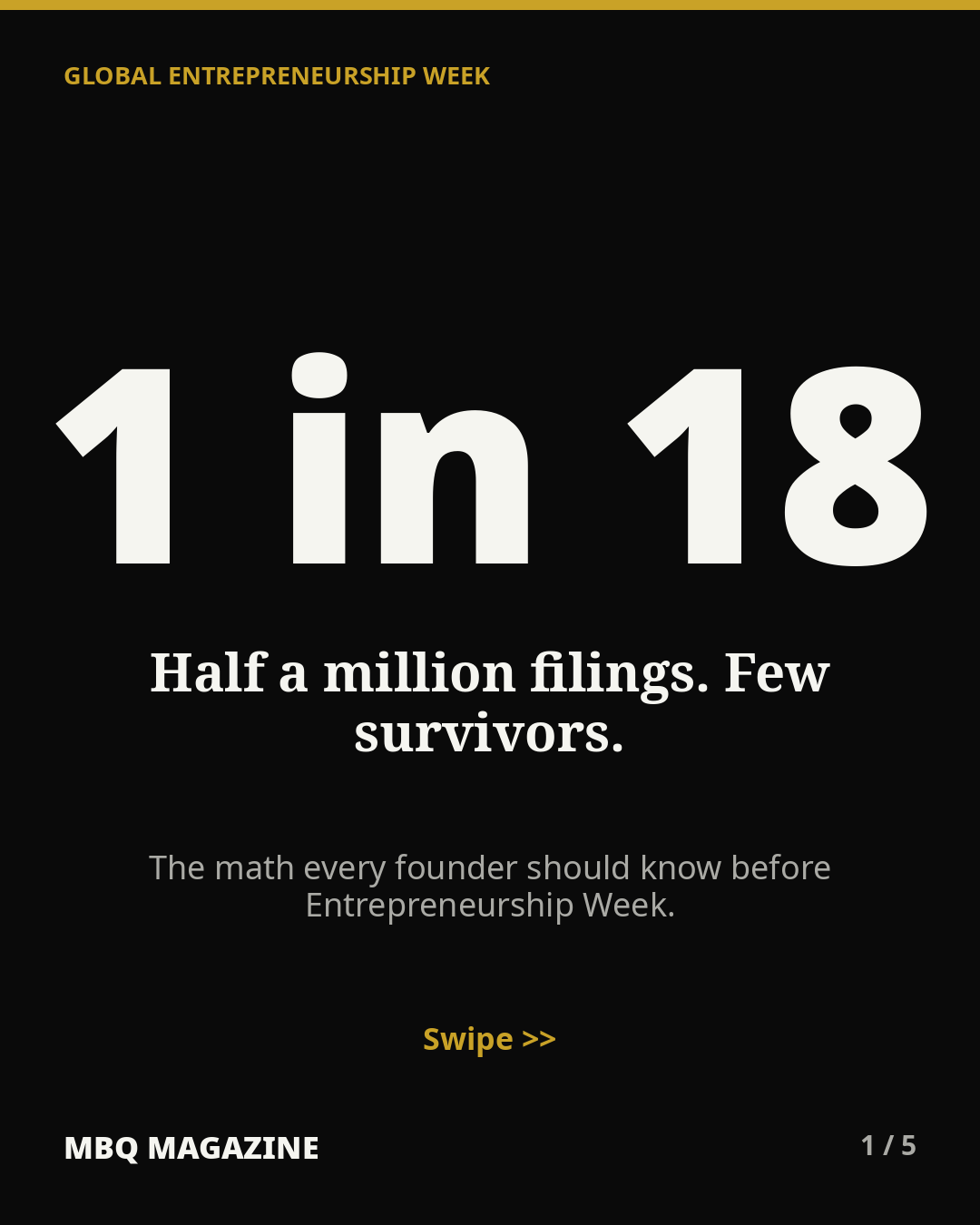
America is not short on ambition. In October, Americans filed 501,609 applications for new businesses, seasonally adjusted, according to the U.S. Census Bureau’s Business Formation Statistics release published November 12. That’s half a million new bets on independence in a single month. Global Entrepreneurship Week began today, November 16, and runs through the 22nd.
The celebration deserves a second number next to it.
The 1-in-18 reality
In the same release, the Census Bureau projected that 27,867 of October’s applications will become businesses with payroll within four quarters, and 37,283 within eight quarters. These are forward-looking estimates from a Census model, not final counts.
MBQ analysis: That works out to about 5.6% of October’s applications becoming employers within a year, roughly one in 18, and about 7.4% within two years.
An application that never hires is not automatically a failure. Many filings become solo consultancies, side businesses, holding companies or real estate vehicles that were never meant to have staff. But for the founder whose plan is to build a company and not just a job, the message is clear: getting from an EIN to a payroll is the first big filter, and most filings never pass through it.
Two industries matter here for MBQ readers. Construction drew 46,163 applications in October and real estate drew 22,914, per the same Census release. Both are crowded doors to walk through.
The release also carried this year’s annual revision, which recomputed seasonal factors and updated past figures. Anyone quoting earlier monthly numbers should check them against the new data.
The second filter: staying alive
For businesses that do hire, the Bureau of Labor Statistics has tracked how long they last. Of private-sector establishments that opened in March 2013, 79.6% were still operating a year later. After five years, 50.6% remained. After ten years, 34.7% were still open.
The first year cuts the deepest. Across all private establishments in that group, the survival rate fell 20.4 percentage points in year one. Construction took the sharpest first-year drop of any major industry, losing 24.0 points. That’s a warning for the many founders now entering the building trades.
MBQ analysis: Combine the two filters and the founder who reaches year ten with a payroll is rare. That is not a reason to avoid starting. It is a reason to build like someone who expects to be in the third that lasts, not the half that doesn’t.
What the survivors say
At the U.S. Chamber of Commerce’s CO—100 Small Business Forum in October, owners who have built lasting companies talked less about hustle and more about discipline. Their points, as reported by the Chamber:
Plan in decades, then work backward. Gideon Stone, CEO of Trade Design Build, the Chamber’s CO—100 Top Business for 2026, said his team set a 25-year goal first and then worked back to 10-, five- and three-year plans, which clarified decisions like hiring. He also stressed being upfront with customers about costs and timelines, the trust gap where many construction firms lose clients.
Surround yourself with stronger financial minds. Joseph Carr, founder of Josh Cellars, said he didn’t understand finance early on and leaned on people who did, asking questions and listening. He also told owners to stay ready to change direction.
Win at home first. Christa Pitts, co-founder of The Lumistella Company, the company behind Elf on the Shelf, urged owners not to underestimate their community and to start close to home before chasing scale.
Be specific enough to be found. Google Vice President Cris Turner warned that vague online listings hurt discoverability as AI tools increasingly match customers with businesses. American Express’s Walter Jackson described choosing a fence-staining company because it listed itself under “stain” rather than the broader “painting.”
The MBQ playbook
Opinion: For founders who want to beat the odds, the data and the forum point to five moves.
Decide what you’re building. A solo practice and an employer company are different games. Choose on purpose.
Treat year one as the hardest year, because the data says it is. Plan cash reserves, not just revenue targets.
Write your 25-year sentence. If you can’t say where the company should be in a generation, your three-year plan has nothing to aim at.
Bring in a stronger finance mind early, whether a fractional CFO, a CPA or an advisory board.
Get specific. Name exactly what you sell and who it’s for, in your listings, your bio and your pitch. Generalists get lost, especially in AI search.
Entrepreneurship Week will be full of launch stories. The more useful story is how to still be open when next year’s week comes around.
MBQ Magazine does not provide investment, legal or tax advice.
Sources
U.S. Census Bureau, Business Formation Statistics, October 2026 (CB26-184, Nov 12, 2026): https://www.census.gov/econ/bfs/current/index.html and https://www.census.gov/econ/bfs/pdf/bfs_current.pdf
Bureau of Labor Statistics, The Economics Daily, establishment survival: https://www.bls.gov/opub/ted/2024/34-7-percent-of-business-establishments-born-in-2013-were-still-operating-in-2023.htm
U.S. Chamber of Commerce, CO—100 forum recap (Oct 22, 2026): https://www.uschamber.com/small-business/small-businesses-have-momentum-heres-how-to-make-it-last
Global Entrepreneurship Network, Global Entrepreneurship Week Nov 16–22, 2026: https://www.genglobal.org/gew