
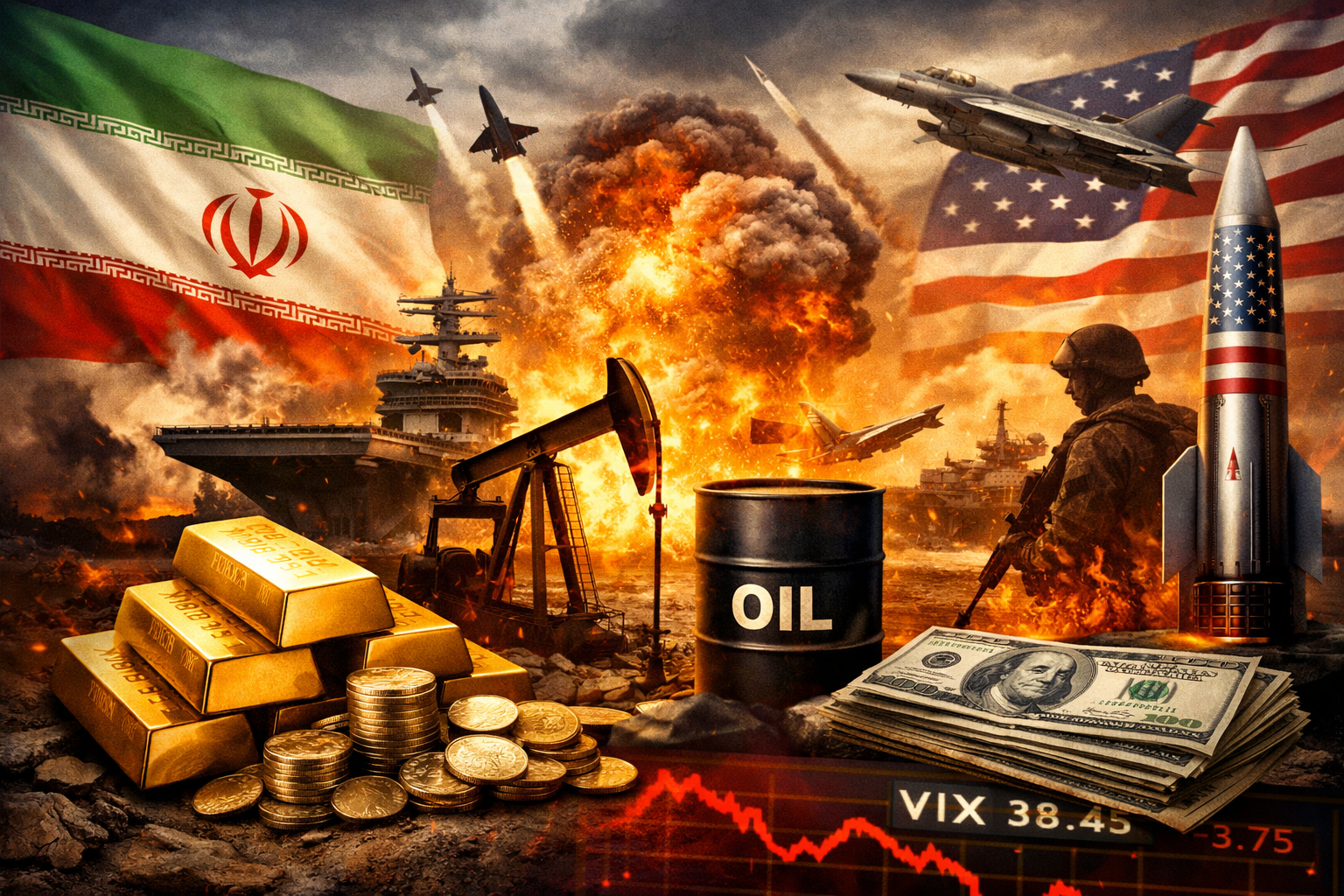
Throughout history, moments of global conflict have reshaped economies, destroyed industries, and created enormous opportunities for those who understood how money moves during geopolitical turmoil. Wars do not simply alter borders or political alliances—they alter capital flows, commodity markets, government spending, and investor psychology.
The escalating tensions between the United States and Iran have once again reminded the world that geopolitical instability can have immediate and far-reaching effects on global markets. Whenever conflict emerges in the Middle East, investors begin to ask the same questions: How will this affect oil prices? Which industries will benefit? Which sectors will suffer? And most importantly—how can one position capital intelligently during times of uncertainty?
The reality is that wars, while tragic and destabilizing, also create predictable financial patterns. Markets react quickly to risk. Governments increase spending on defense and security. Supply chains become disrupted. Investors flee risky assets and seek safety in commodities and strategic industries.
For those who understand these patterns, periods of conflict can become moments of strategic repositioning rather than panic.
This article explores the economic mechanics of war and outlines how investors historically position their portfolios during times of geopolitical conflict.
Understanding the Economic Impact of War
Before discussing specific investment strategies, it is important to understand why markets behave the way they do during international conflict.
War affects the global economy in several major ways.
First, conflict introduces uncertainty. Investors dislike uncertainty more than almost anything else. When the risk of instability rises, markets become volatile and capital quickly moves away from speculative investments.
Second, war disrupts supply chains. Shipping routes, transportation infrastructure, and commodity pipelines can be threatened or restricted. When supply becomes uncertain, prices often increase rapidly.
Third, governments dramatically increase spending during wartime. Defense budgets expand, military equipment orders increase, and governments invest heavily in security technologies. This creates strong financial tailwinds for certain industries.
Finally, geopolitical crises shift global capital flows. Investors tend to move money into “safe haven” assets such as gold, oil, or strategic industries that benefit directly from the conflict environment.
These dynamics create predictable market reactions.
Understanding them is the foundation for positioning capital wisely.
The Middle East and the Global Oil System
The United States–Iran conflict has particularly large implications because it involves the Middle East, a region that sits at the center of global energy production.
One of the most strategically important locations in the world is the Strait of Hormuz. This narrow waterway connects the Persian Gulf to the global shipping network and is responsible for transporting roughly one-fifth of the world’s oil supply.
Any threat to this shipping route immediately triggers anxiety in energy markets.
If shipping through the Strait becomes disrupted—even temporarily—the global oil supply can tighten dramatically. When supply drops while demand remains constant, prices tend to rise rapidly.
Historically, Middle Eastern conflicts have triggered sharp spikes in oil prices. Investors remember events such as the Gulf War, the Iraq War, and various regional crises that pushed oil prices significantly higher.
Because of this, energy markets tend to react almost instantly whenever geopolitical tensions escalate in the region.
For investors, this creates one of the most significant opportunities during wartime.
Energy Investments: The First Sector to React
Energy is almost always the first major sector to move during geopolitical conflict in the Middle East.
Oil markets respond immediately to any threat of supply disruption. Traders and institutional investors begin pricing in the possibility that production could slow or shipping lanes could become unsafe.
As a result, energy companies often see their stock prices rise when oil prices increase.
Large oil producers such as ExxonMobil, Chevron, and ConocoPhillips tend to benefit directly from higher oil prices because their revenues increase with the price of crude.
Energy sector exchange-traded funds also become popular investment vehicles during these periods. These funds allow investors to gain exposure to the broader energy market without selecting individual companies.
Energy service companies also benefit from rising oil prices. These firms provide drilling equipment, infrastructure services, and technological support to oil producers. When energy companies increase production or exploration efforts, service providers receive more contracts.
In short, when oil prices rise, the entire energy ecosystem can benefit.
This is why professional investors often rotate capital into energy stocks during geopolitical crises involving major oil-producing regions.
Defense Companies: The Business of War
While energy markets respond immediately to supply disruptions, defense companies benefit from a different economic dynamic—government spending.
War requires massive resources. Military operations depend on aircraft, missiles, drones, cybersecurity systems, radar equipment, satellites, and advanced weapons technologies.
Most of these systems are manufactured by large defense contractors.
Companies such as Lockheed Martin, Northrop Grumman, Raytheon Technologies, and General Dynamics are among the largest suppliers of military technology in the world.
When geopolitical tensions escalate, governments frequently increase their defense budgets. New weapons systems are ordered, military stockpiles are replenished, and research into advanced defense technology accelerates.
These contracts often last for years, which means defense companies can experience long periods of sustained revenue growth during times of conflict.
For investors, defense stocks represent a unique category of “conflict-resistant” investments. Unlike many industries that struggle during wartime, defense contractors often thrive because their products become essential national security assets.
This is one of the reasons defense stocks are closely monitored by institutional investors whenever geopolitical tensions rise.
Precious Metals: The Safe Haven Trade
While energy and defense companies benefit directly from war, precious metals serve a different purpose in the investment ecosystem.
Gold and silver have historically functioned as stores of value during periods of instability. When investors fear economic disruption, inflation, or financial system stress, they often move capital into precious metals.
Gold in particular is widely viewed as a safe-haven asset.
Unlike currencies or stocks, gold is not tied to any single government or corporation. It has been used as a store of wealth for thousands of years.
During times of geopolitical tension, investors often increase their allocation to gold as a way to protect their wealth from market volatility.
Silver also tends to move alongside gold, though it is more volatile because it is used both as an industrial metal and as a financial asset.
For modern investors, exposure to precious metals can be achieved through physical metals, specialized exchange-traded funds, or mining companies.
While precious metals may not produce income like stocks or bonds, they serve an important role in protecting portfolios during uncertain times.
Volatility Trading and Short-Term Opportunities
Another important aspect of wartime investing involves market volatility.
Geopolitical crises often cause rapid price swings across multiple asset classes. Currency markets, commodity markets, and stock indexes can experience large daily movements as new information emerges.
For short-term traders, these movements create opportunities.
Oil futures, natural gas markets, and currency pairs tied to commodity economies often experience significant volatility during geopolitical events.
However, volatility trading also carries substantial risk. Markets can reverse direction quickly as new information emerges or diplomatic negotiations change the outlook of a conflict.
Because of this, many professional investors treat volatility trading as a smaller portion of a diversified strategy rather than the core of a portfolio.
Industries That Often Struggle During War
While some sectors benefit from conflict, others tend to suffer.
Airlines are particularly vulnerable to rising oil prices. Fuel represents one of the largest operating costs for airlines. When oil prices surge, airline profitability often declines.
Travel and tourism industries may also struggle as geopolitical tensions discourage international travel and increase security concerns.
Shipping and logistics companies can face disruptions if key maritime routes become unsafe or heavily regulated.
Manufacturing sectors that rely heavily on global supply chains may experience delays or cost increases if conflict disrupts transportation infrastructure.
Understanding which industries are likely to struggle during wartime can be just as important as identifying which sectors will benefit.
Portfolio Strategy During Geopolitical Crisis
Professional investors rarely concentrate their entire portfolios in a single sector during geopolitical crises.
Instead, they tend to construct diversified strategies that balance opportunity with risk management.
A typical wartime portfolio approach may involve allocating capital across several key categories:
Energy investments may represent a significant portion due to the potential for rising oil prices.
Defense companies may serve as long-term holdings tied to increased government spending.
Precious metals may function as a hedge against economic instability.
Cash reserves may be maintained to provide flexibility and allow investors to take advantage of new opportunities as they arise.
Some investors may also allocate a smaller portion of capital to short-term trading strategies designed to capture market volatility.
The goal is not to predict every market movement perfectly but to position capital in areas that historically benefit from geopolitical instability.
Timing the Market Response
One of the most important lessons from past conflicts is that markets often react quickly.
Oil prices may surge in the early days of a conflict as traders anticipate supply disruptions. Defense stocks may begin rising once governments announce increased military spending.
However, markets can also stabilize once the initial shock fades and investors begin assessing the longer-term implications of the conflict.
Because of this, many experienced investors focus on positioning early in the conflict cycle rather than reacting after the narrative becomes widely accepted.
The first few weeks or months of a geopolitical crisis often present the largest market movements.
The Long-Term Geopolitical Landscape
The current tensions between the United States and Iran also highlight broader shifts in global power dynamics.
Energy security remains one of the most important strategic concerns for governments around the world. Control over energy resources and transportation routes continues to shape geopolitical alliances and rivalries.
At the same time, technological warfare is becoming increasingly important. Cybersecurity, drone technology, satellite systems, and artificial intelligence are transforming modern military capabilities.
These trends suggest that defense technology and energy infrastructure will remain strategically important sectors for many years to come.
For investors who take a long-term view, understanding these structural changes may provide valuable insights into where capital will flow in the future.
The Psychology of Investing During Crisis
Perhaps the most important factor in wartime investing is psychological discipline.
When geopolitical crises unfold, media coverage can become intense and emotional. Headlines often emphasize worst-case scenarios, creating widespread fear among investors.
Fear can lead to poor financial decisions, such as selling assets at the bottom of market declines or chasing investments after they have already surged.
Successful investors tend to approach geopolitical events with calm analysis rather than panic.
They focus on understanding economic mechanisms rather than reacting to headlines.
War changes the global landscape, but it also creates new patterns of opportunity.
Recognizing those patterns requires patience, discipline, and strategic thinking.
Conclusion: Strategy Over Panic
War is one of the most disruptive forces in human history. It reshapes politics, economies, and societies.
But in the world of finance, conflict also reveals important truths about how markets operate.
Energy markets react to supply risk. Defense companies benefit from increased government spending. Precious metals attract investors seeking safety. Volatility creates opportunities for traders willing to manage risk.
Understanding these dynamics allows investors to position themselves strategically rather than react emotionally.
The goal is not to celebrate conflict or profit from suffering. Rather, it is to understand the economic realities of geopolitical events and make informed financial decisions in an uncertain world.
History shows that markets will continue to respond to global events in predictable ways.
Those who study these patterns can navigate turbulent times with greater confidence—and sometimes even emerge stronger on the other side.