
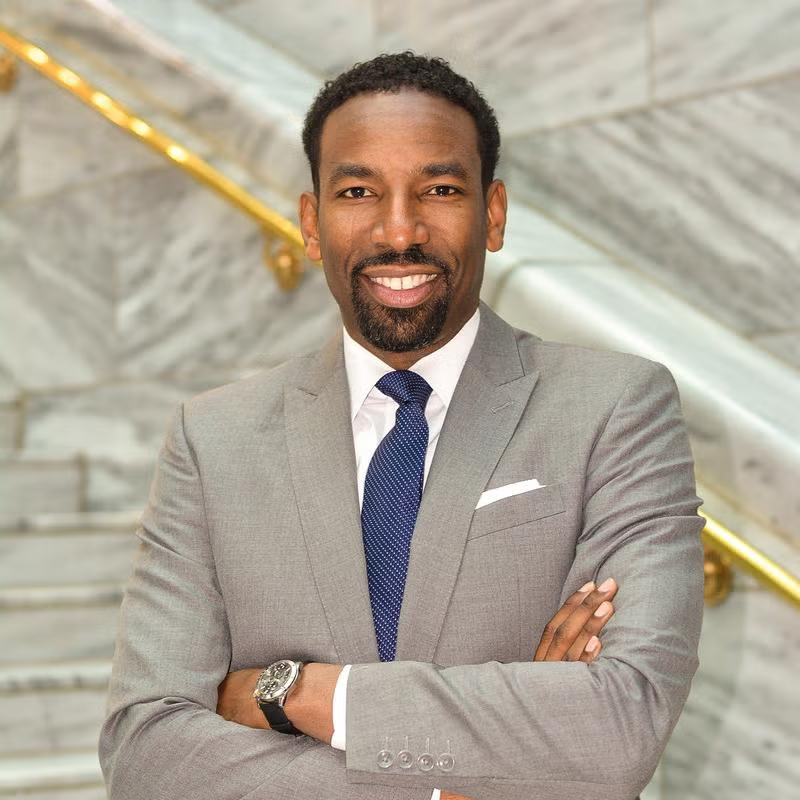
Andre Dickens’ Second Term Mandate: A Veteran’s View on Atlanta Politics and the Economics of Equity
I. The Mandate and the Moment: Defining Atlanta’s Future
(Approx. 200 Words)
In a city whose political history is as rich and complex as its red-clay soil, the recent, decisive reelection of Mayor Andre Dickens in Atlanta wasn’t merely another Election Day footnote. It was a roar—a clear, unambiguous mandate from a citizenry grappling with the very definition of what the “Black Mecca of the South” means in the 21st century.
As a 48-year-old Black man who’s spent decades navigating the shifting currents of the publishing business, writing on everything from mayoral races to municipal bond offerings, I see this victory through a dual lens: political triumph and profound city economics. Dickens didn’t just win; he secured a clean, outright majority against his challengers, avoiding a runoff and signaling a deep, broad-based approval of the policy trajectory he’s set. In the often-fractious landscape of Atlanta politics, where personality and patronage have sometimes overshadowed policy, this immediate, first-round victory is a powerful endorsement of his technocratic, metrics-driven approach to urban leadership.
His mandate is clear: continue the policy synthesis of aggressive public safety measures and expansive urban development programs, all while tackling the crushing pressure of affordable housing—the single greatest existential threat to Atlanta’s middle and working classes. This second term isn’t a victory lap; it’s the critical four-year window where legacy is forged, where the rhetoric of equity must fully translate into the reality of stabilized neighborhoods and accessible economic opportunity for all residents.
II. The Political Ground Game: Securing the Coalition of Prosperity
Andre Dickens Reelection: A Turning Point for Atlanta
(Approx. 350 Words)
The Atlanta mayoral race, officially nonpartisan, has long been a showcase for the Democratic Party’s regional divisions and unifying forces. What separated Andre Dickens from the pack this cycle was his ability to successfully bridge the often-gaping chasms in the city’s political landscape. He didn’t just win the Black vote; he solidified a potent coalition built upon the city’s established business community, the increasingly influential younger tech and creative class, and, crucially, the beleaguered Black middle class in the South and Southwest sections of the city.
The political coalition Dickens built recognized the fundamental interconnectedness of public safety and economic stability. For a city that relies heavily on convention tourism, film production, and corporate headquarters—think Coca-Cola, Delta, and Home Depot—perception is reality. The message from the business sector was unequivocal: stability and governance matter more than populist, reactive policy shifts. Dickens delivered on that front, adopting a nuanced “more police and more programming” stance that satisfied both the desire for immediate security and the long-term need for community investment.
His challengers failed precisely because they couldn’t dismantle this effective synthesis. They often focused too narrowly on single issues—either over-indexing on police critique or offering vague economic promises. Dickens, a former City Council member and a chief development officer for a tech non-profit before his first term in 2022, brought an undeniable fluency in capital markets, zoning laws, and municipal budgeting that resonated with voters tired of political theater.
This is a second term signal that Atlanta voters prioritize pragmatic governance. They saw in Dickens a mayor who not only understands the spreadsheets of city economics but who is also personally invested in preserving the cultural and economic opportunities that defined the “Black Mecca.” His mandate is permission to move aggressively on his comprehensive blueprint, backed by the credibility of a decisive victory.
III. The Crux of City Economics: Affordable Housing and the Crisis of Gentrification
(Approx. 400 Words)
No single issue defines the soul of modern Atlanta—and its economic risk—more than affordable housing. The city has become a victim of its own success, where development along corridors like the BeltLine has catalyzed a relentless wave of gentrification, pushing legacy residents and the essential workforce further out into the periphery.
Dickens’ signature policy goal—the commitment to fund and facilitate 20,000 units of new or preserved affordable housing—is the most potent tool in his city economics arsenal. This is a monumental task that requires leveraging every available mechanism:
-
Bond Funding: The use of public bonds to capitalize development authorities and housing trusts. This moves beyond annual budget constraints and is a declaration of capital priority.
-
Inclusionary Zoning: Mandating that developers set aside a percentage of new units at specific price points. This is a crucial, if often politically charged, mechanism for socializing the cost of affordability back onto the private sector profiting from the city’s growth.
-
Public-Private Partnerships (P3s): Utilizing publicly owned land (old school sites, surplus city property) and partnering with developers to maximize the number of affordable units without simply selling the land to the highest bidder.
The veteran publisher in me recognizes the inherent political danger in this policy. Every unit built is a victory, but the scale of the crisis is immense. Atlanta is rapidly losing its share of Black residents—the demographic backbone of its political and cultural identity. If Dickens fails to deliver on the 20,000 units, the economic and cultural consequences are irreversible. The displacement of the workforce stresses transit systems, reduces local tax collection, and fundamentally alters the socio-economic equilibrium that has sustained Atlanta’s unique character. This is where politics meets balance sheets: housing is the foundation upon which all other economic indicators rest.
IV. Public Safety: The Foundational Infrastructure for Economic Growth
(Approx. 400 Words)
In the discourse of urban development, infrastructure usually means roads, bridges, and water lines. But in 21st-century Atlanta, public safety is, effectively, the foundational infrastructure for economic growth. A perception of runaway crime acts as a massive deterrent to corporate investment, talent acquisition, and even residential choices, particularly in high-value commercial districts like Midtown and Buckhead.
Dickens understood this linkage immediately. His policy was a departure from the “defund” and “deconstruct” conversations that dominated national political chatter. Instead, he pursued a strategy of professionalizing and expanding the police force while simultaneously pouring resources into preventative measures like youth programming, job training, and mental health services. This policy synthesis is the key to unlocking the next phase of Atlanta’s economic boom.
The Crime and Business equation is simple: Businesses demand predictability and security. When retailers, restaurants, and office tenants feel unsafe, they leave, reducing the tax base and creating blight. Dickens’ approach—boosting police presence and clearance rates—addressed the immediate business imperative. Meanwhile, his focus on “programming,” addressing the root causes of crime, is the long-term, equitable investment that prevents the need for constant, reactive policing.
For the Black community, this approach is particularly significant. We need safety as much as, or more than, any other segment of the city. A secure environment allows small businesses to thrive, keeps neighborhood investment stable, and ensures children can walk safely to school. By successfully navigating the debate and implementing a comprehensive strategy, Dickens reassured the powerful economic stakeholders (both corporate and neighborhood-level) that Atlanta is open for business, but that business must contribute to the city’s overall economic stability. This is the art of balancing enforcement with equity—a delicate tightrope walk that defines his political capital.
V. Infrastructure, Transit, and the Urban Blueprint
(Approx. 350 Words)
A city is ultimately a complex machine, and its efficiency is dictated by the flow of people and goods. Here, Dickens has also been handed a clear mandate to accelerate investment in Atlanta infrastructure and regional transit. The challenge is regional, but the primary funding responsibility falls on the city.
The critical piece of the puzzle is MARTA (Metropolitan Atlanta Rapid Transit Authority). For decades, political inertia and suburban resistance prevented MARTA from evolving into a truly regional system. Dickens must use his second term to solidify the city’s commitment to transit expansion, not just within the city limits but as a lever to pull the surrounding counties toward a shared, sustainable vision. Transit access is an equity issue: it connects outer-lying, often lower-income neighborhoods to job centers like Downtown, Midtown, and the airport, reducing commute times and vehicle dependence, and thereby increasing disposable income.
Furthermore, capital projects—such as water and sewer upgrades, road improvements, and the expansion of the city’s green spaces—are vital for retaining high-value residents and attracting new investment. These projects are costly, but they are the non-sexy, long-term investments that underpin the tax base. Successfully managing the large-scale implementation of these bonds and capital improvement projects is the ultimate test of his administrative competence.
This Urban Development blueprint, therefore, is not just about concrete and rail; it’s about competitive positioning. To compete with peer cities like Charlotte, Nashville, and Dallas, Atlanta cannot afford stagnant infrastructure. Dickens’ victory means voters believe he has the capacity to leverage the city’s financial tools to execute this ambitious and necessary construction agenda, ensuring the physical layout of the city supports, rather than stifles, its economic aspirations.
VI. Conclusion: The Path Forward and the Legacy of the ATL
(Approx. 300 Words)
Andre Dickens’ reelection is more than the continuation of a term; it’s the definitive selection of a governance philosophy. It is a victory of Policy Implementation over perpetual campaigning, a preference for balance sheet prudence over political showmanship. His mandate is a challenge: to prove that Atlanta can be a global economic powerhouse while simultaneously being a laboratory for urban equity.
The major challenges are immense. He faces the constant political headwinds from the State Capitol, where a Republican-led state government often seeks to preempt the policy decisions of the overwhelmingly Democratic capital city. He must also battle the deep, structural income inequality that threatens to splinter the city’s social fabric.
To secure his Andre Dickens Legacy, he must deliver three things:
-
Tangible Affordable Housing: The 20,000 units must become a visible reality, stemming the tide of displacement.
-
Sustained Public Safety: Crime trends must continue downward, solidifying the confidence of residents and investors.
-
Transit Realization: Meaningful progress on MARTA expansion and infrastructure modernization must be undeniable.
The history of Atlanta is a story of Black political power and economic vision, from the Civil Rights era mayors to today. Dickens’ second term places him squarely at the intersection of these two forces. He has four years to govern with the decisive force of his mandate, ensuring that the Atlanta Future remains one where prosperity is not exclusive but broadly shared, preserving the soul and the strength of the Black Mecca for the generations that follow. It’s a heavy lift, but in this city, a heavy lift is just the cost of doing business.