

If you have been waiting for the Atlanta housing market to “come back to normal,” October gave you half of that sentence. According to Georgia MLS figures for the 29-county Atlanta metro, the median residential sale price was $383,400 last month, down 0.9% from September and up only 0.9% from a year earlier. Closings fell to 4,751, almost 18% below October 2025. Active listings rose to 27,383, and inventory stood at 4.83 months. That is not the frenzy of the early 2020s. Buyers have time, and they have a little leverage.
The other half of the sentence arrived Thursday, and it was not friendly. In its November 19 survey, Freddie Mac put the average 30-year fixed mortgage at 7.28%, up from 7.11% the week before and up from 6.26% a year earlier. The 15-year rate jumped to 6.66%. Four weeks of modest relief reversed in a single print, just as the Federal Reserve’s October minutes, released November 18, showed officials still leaning toward further rate increases.
The window in Atlanta right now is inventory and negotiation. It is not cheap credit.
What the Atlanta housing market is actually offering
Start with the price, then look at the volume. A median of $383,400 means half of October’s sales closed below that number and half closed above it. The average sale, $488,865, is higher because a thinner slice of expensive homes pulls the mean up. Year over year, prices barely moved. Sales did. When closings drop almost 18% and listings drift higher, sellers lose the ability to dictate terms. That is the opening: inspection periods that mean something, credits, repairs, and a refusal to bid over list because you are afraid of losing the house on a weekend.
What it is not offering is a reset to the payment you could have made two or three years ago. A 7.28% 30-year rate on a loan near that metro median is a heavy monthly bill, and it can move again before a December closing. The Fed held the federal funds rate at 3.75% to 4% on October 28, and the minutes made clear that most participants still expect further tightening under their baseline outlooks. Mortgage rates do not move in a straight line with the funds rate, but they do not ignore it either.
So the useful question is not “Will rates be 5% next spring?” Nobody writing this can promise you that. The useful question is, “Can I carry this payment at today’s rate, with a little room if it stays here or goes higher, on a house I have actually inspected?” If the answer is no, walking away is discipline, not a missed destiny. If the answer is yes, waiting for a perfect print is how people talk themselves out of a house they could have bought.
We have already written about the larger squeeze. In The Provider, Rewritten, the national housing math is the reason a paycheck that barely beat 1973, after inflation, no longer buys the same life. Atlanta is one local version of that story: prices that refuse to fall much, and financing that has not come back down.
The homeownership gap is the part that should bother you
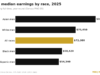
Nationally, the housing problem is not only price. It is who gets to own. The Census Bureau’s Housing Vacancies and Homeownership survey for the third quarter of 2026 puts the U.S. homeownership rate at 65.5%. For non-Hispanic White households, it is 75.1%. For Black households, it is 44.4%, down from 45.7% a year earlier and from 45.4% in the second quarter. That is a gap of more than 30 percentage points, and it widened this year.
A house is still one of the main ways a family turns income into ownership that can be passed down. When Black homeownership slips while the overall rate holds or edges up, the wealth gap does not wait for a better headline. It compounds.
That is why the boring work matters more than a hot take on rates. A rejected file at 7.28% does not get easier because you liked the kitchen. Credit repair is not glamorous, but it is often the difference between a rate you can carry and one you cannot, or between being approved at all and watching the house go to someone else. Get your credit reports. Dispute the errors. Pay down the balances that are punishing the score. Have a down-payment plan that does not leave the household with no cash after closing. If you are self-employed, start organizing the tax returns and bank statements a lender will ask for before you fall in love with a listing.
Buyers, and a word for investors
For a primary residence, the play in this market is patience plus readiness. Get pre-approved, and understand that a pre-approval is a snapshot, not a lifetime pass, especially if rates hop the way they did between November 12 and November 19. Look at more than one neighborhood. Use the 4.83 months of inventory. Make the inspection real. Do not compete with a cash offer by stripping your own protections.
For investors, be just as sober. Residential inventory and slower sales can mean a better entry on a rental, but only if the rent covers a 7% mortgage, taxes, insurance, vacancies and repairs, with margin. Commercial is a different book. We have already flagged record office distress as a 2026 investment problem. Do not treat a soft residential market as a signal that every property type is on sale.
A general guide to navigating the real estate market is still a reasonable primer on process. The 2026 layer, in Atlanta, is this: you finally have some choice, and you still do not have cheap money. The men who buy well in this window will be the ones who underwrite the payment they have, not the payment they are hoping the Fed will eventually grant them.